![かぎ針編みレシピ・無料編み図 Ronique [ロニーク]|基本の編み方から動画解説まで](https://ronique.jp/wp-content/uploads/2025/04/ronique_toplogo.webp)
Useful tips for beginners that often appear in crochet patternsKnitting symbols (knitting chart symbols)We will introduce you to the following.
Not only can you memorize the shapes of the symbols, but you can also master how to knit on the spot.Individual knitting instructions with videos for all symbolsI've attached a link to.
If you are unsure how to read a knitting pattern, please return to this page at any time and use it as a dictionary.
Like the list at the end of a knitting book:From basic knitting methods to slightly special symbolsI've collected them all together so you can see them all at once.
It is also useful when knitting free patterns from overseas.While our "English symbol list」So please use it as well.
Index
Symbols used in knitting patterns
You can view the knitting video and image explanation page by clicking the link in the table below.






Digging deeper into knitting symbols
The difference between "splitting and knitting" and "scooping and knitting"
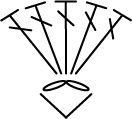
As shown in the list above, the difference between inserting the needle into the first stitch of the previous row and knitting (or "splitting" a chain) and picking up the entire chain stitch of the previous row and knitting it into a bundle can sometimes be seen by looking at the knitting symbols.
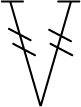
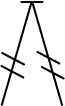
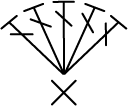
For example, the knitting symbols below all indicate inserting the needle into the first stitch of the previous row (or "splitting" the chain).
When splitting and knitting, the bases of the double crochet and middle double crochet symbols are stuck together.
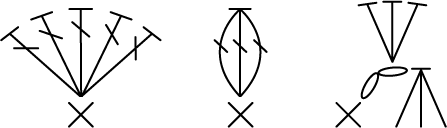
Conversely, when the base of a symbol such as a double crochet is separated, as in the knitting pattern symbol below, it indicates that the stitches from the previous row should be gathered together and knitted.
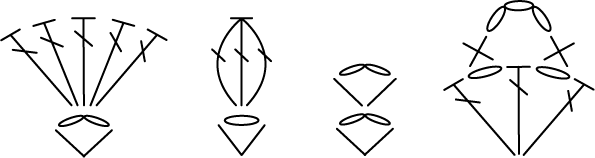
You may be thinking that the knitting pattern symbol on the far right is hard to understand because it only has one round stitch!
When knitting just one stitch, it is not possible to express whether to attach the base or leave it separate, so if there are no instructions in the recipe it is up to the knitter to decide, but I think in most cases it will be fine to just scoop it up into a bundle and knit it.
Even in Ronique's recipes, the yarn is often scooped into bundles for the simple reason that it is easier to knit.
There are many different ways to represent knitting patterns, so this is not guaranteed, but please use it as a reference if you see symbols like these and are unsure.
Picots and chain loops
The knitting pattern symbols for picot stitch are also listed above.
This knitting technique is also used to make chain loops.
We will also look at the knitting symbols for similar chain loops and the differences in their finished shapes.
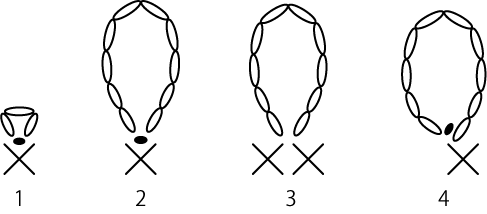
Number 1 is the knitting pattern symbol for a common picot.
Picots are often made by knitting three chain stitches, but if you increase the number of chain stitches, you will end up with a chain loop like number 2.
By adjusting the number of stitches, this chain can be used to make button loops, etc.
Although it is a similar chain loop, in the case of number 3, it indicates that you should knit the right knit stitch → 10 chain stitches → left knit stitch in that order.
For number 4, crochet a quarter stitch followed by a chain of 10 stitches and then work a slip stitch into the first chain stitch.
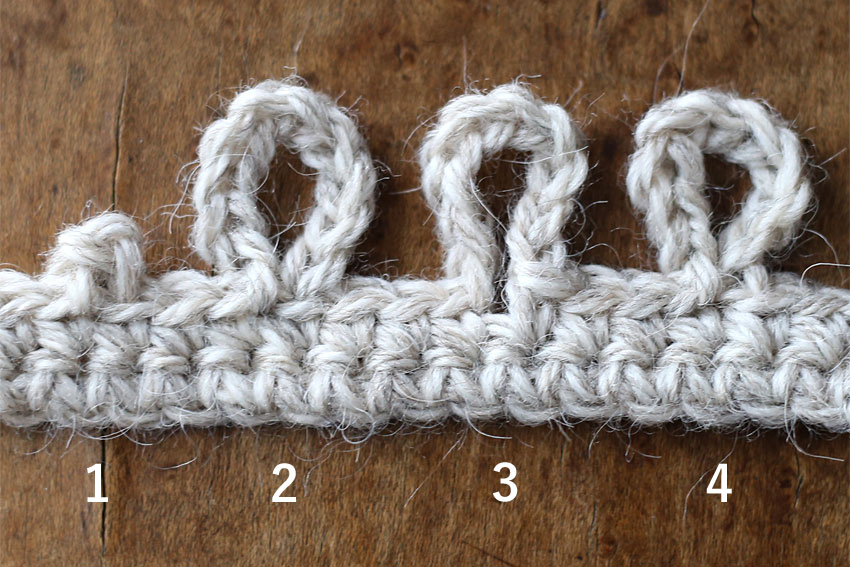
The actual knitted fabric will look like this.
You may not see numbers 3 and 4 often in knitting patterns, but I wanted to see what difference a different way of representing a knitting pattern can make to the finished product.
Japanese knitting symbols and international text notation
In Japan, it is common for crochet to come with a pattern, but overseas it is common to see cases where there is only text but no pattern.
Such text-based explanations seem to have evolved to convey information in more concise terms.
As someone who creates recipes, being able to create recipes using only text is very appealing, so it seems well worth learning phrases and explanation methods that can be used to communicate even without a knitting pattern.
However, for complex projects, a knitting pattern that allows you to grasp the whole picture at a glance is still a great idea.
Unlike knitting with needles, crochet patterns require each piece to be represented with a different symbol, which makes it difficult for the person creating the patterns (especially the data for the patterns), but I think the ease of understanding is worth the effort.
The crochet symbols are very well designed, as they are linked to the actual height of the stitches, with the height of a single stitch being "1," the height of a double crochet being "2," and the height of a double crochet being "3," etc.
The pull-up stitch also gives the impression of scooping up the entire stitch from the previous row, which perfectly matches the image of the operation.
In that sense, crochet symbols may be easier to understand just by looking at them.
If you are a beginner at crocheting, there may be some symbols that you are seeing for the first time, but you will soon get used to them, so until then, please refer to pages like this one.
If you want to know more about crochet
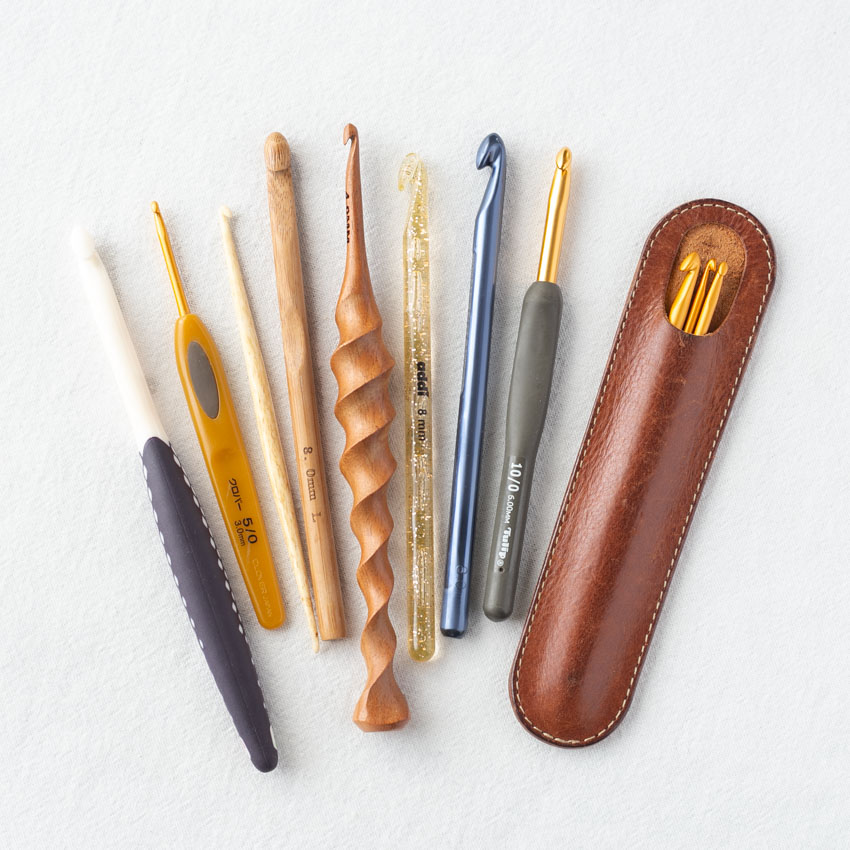
Crochet for Beginners: A Step-by-Step Guide to Tools and Stitches
We have compiled the basics of crocheting that will be useful for beginners, from choosing crochet tools to knitting instructions that you can watch in video, and recipes that you can use right away.
This is a complete guide that is also recommended for those who want to try crocheting on their own.

