![かぎ針編みレシピ・無料編み図 Ronique [ロニーク]|基本の編み方から動画解説まで](https://ronique.jp/wp-content/uploads/2025/04/ronique_toplogo.webp)
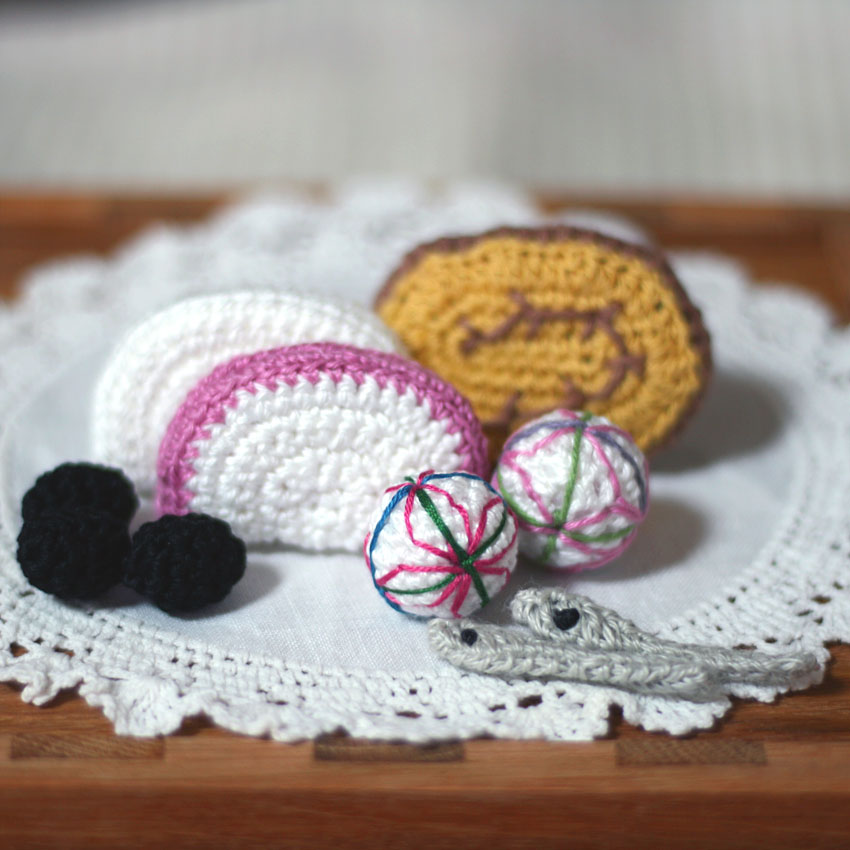
This is a crocheted piece.
This is a sequel to the crocheted New Year's dishes.
This time, I tried knitting traditional items such as kamaboko and datemaki. I need to knit a few more black beans and tazukuri.
Temarifu is so cute that it makes you want to try making and using all sorts of things.
Since we are already entering the New Year, I think I will make the bento boxes next year.
Although it's a bit late, I'll upload the recipe.
Yarn and Crochet Hook Size
Medium-fine cotton thread (white, pink, yellow, beige, black, gray)
Thread for the Temari Fu pattern (pink, green, blue, etc.)
No. 3 key
Yarn needles and embroidery needles if necessary
Polyester wadding
Finished Size
Kamaboko 5 x 3cm Datemaki 5 x 3.5cm Temarifu diameter 2cm
Crochet Pattern
Kamaboko knitting pattern
Datemaki knitting pattern
Instructions
[Kamaboko]
①Please check the knitting pattern for the kamaboko.
Start by casting on two chain stitches, then work back and forth in a circular knit stitch. Be careful of the direction you are knitting.
② For the kamaboko with a pink top, use pink yarn only on the 7th row (final row).
③ Knit two identical pieces. Once you have finished knitting the second piece, continue knitting the gusset using double crochets without cutting the yarn.
When knitting a double crochet, pick up just one stitch on the other side of the previous row and knit a double crochet.
For the arch part at the top of the kamaboko, pick up the stitches from the previous row without increasing or decreasing the number of stitches, and for the bottom part, pick up the stitches and knit an appropriate number of medium double crochets, checking the balance so that the stitches are evenly spaced.
For the pink kamaboko, knit the top arch with pink yarn and use white yarn for the bottom to knit the gusset.
④ Once you have knitted the gusset into one piece of kamaboko, leave the end of the yarn long, combine it with another piece, and secure it with a rolled stitch (be sure to add the filling before it is completely closed).
At this time, the upper arch part is sewn by scooping up the last half stitch of the other part.
[Datemaki]
①Please also check the knitting pattern for the Datemaki.
Start by chaining 6 stitches. For the fourth row, alternate between double crochets and double crochets.
② Knit two of the same piece, and when you finish knitting the second piece, do not cut the yarn, but continue knitting the gusset.
To make the gusset, pick up just one stitch on the other side of the second row (the chain stitch) and crochet it all the way around with double crochets.
③ Once you have knitted the gusset, leave the end of the yarn long and use it to wrap around another piece of yarn and secure it (be sure to add the filling before closing it).
In this case too, for the second row of stitches on the other part, scoop up only one stitch (half a stitch) on the gusset side.
[Temari Fu]
① Start by casting on the loop, then knit 6 quarter stitches in the first row. From the second row onwards, increase or decrease the number of stitches as shown in the table below.
Fill with cotton halfway through, then thread the yarn through the final stitch and squeeze.
② Once the gluten base is complete, use thin yarn or embroidery thread to create your desired pattern.
| Number of steps | Increasing or decreasing the number of stitches |
| 8 | 6 (-6) |
| 7 | 12 (-6) |
| 4 to 6 | 18 (±0) |
| 3 | 18 (+6) |
| 2 | 12 (+6) |
| 1 | 6 |
[Black beans]
① Start by making a loop cast-on and knit 6 quarter stitches in the first row.
Increase 3 stitches in the second row (knit 2 stitches every other stitch in the previous row), then work the same number of stitches in rows 3 and 4. In row 5, decrease 3 stitches.
Add cotton halfway through, then thread the yarn through the final stitch and squeeze.
[Rice field cooking]
① Make a chain with 13 stitches, then pick up one chain on the other side of the cast-on and the back of the chain, and knit as shown in the diagram below.

② Knit two pieces of the same fabric as ① and sew them together with a roll stitch.
3. Attach the eyes by embroidering them onto the knitted fabric. You can attach the eyes either before or after joining the two pieces together, whichever is easier for you.
Your work
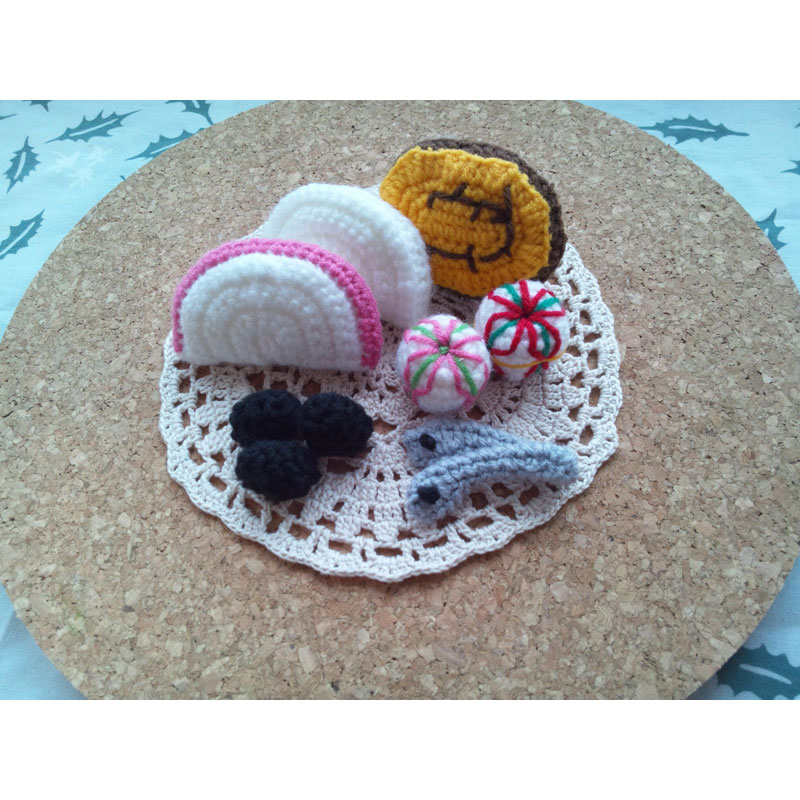
Rico's "Osechi cuisine (kamaboko, datemaki, temarifu)"
It turned out very colorful.
I thought the other recipe, "Shrimp," was also amazing, but I was also impressed by how well thought out this little creation was.
*Rico*Rico*Diary
http://ricocrochet.blog.fc2.com/
▶Rico's solo exhibition page
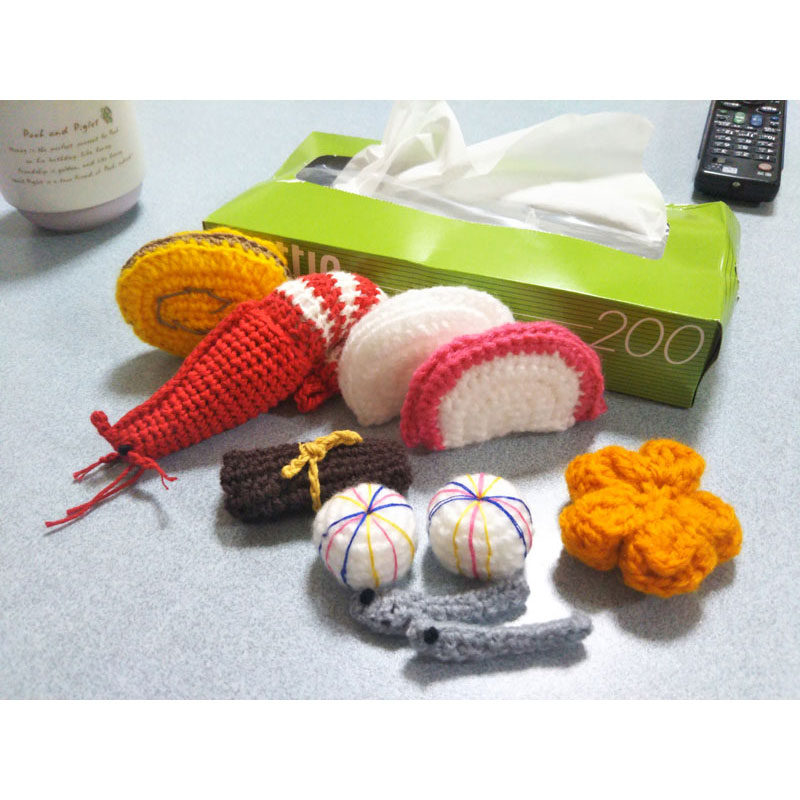
Mii.'s "Osechi cuisine (kamaboko, datemaki, temarifu)"
I did my best
I'll buy some weights and pack them in now.

