![かぎ針編みレシピ・無料編み図 Ronique [ロニーク]|基本の編み方から動画解説まで](https://ronique.jp/wp-content/uploads/2025/04/ronique_toplogo.webp)
Index
Are classifications such as medium-thin and medium-thick also used overseas?
When knitting using a knitting pattern or recipe, the first thing you check is probably the information about the yarn used.
In Japan, expressions such as medium-thin, medium-thick, and extra-thick are commonly used to refer to thread thickness.
Even if the yarn does not have such a description, you may naturally understand in your head that "this is about medium thickness" based on the needle size listed on the band.
And if you broaden your horizons to include not only Japanese yarns but also yarns from overseas, you'll have more options to choose from, which can be exciting.
Conversely, you may want to knit an overseas recipe using Japanese yarn.
For overseas yarns, the weight of one ball is usually written in grams and meters on the belt, so you can use that to calculate the thickness ("How can I find threads that are similar in thickness?") I think it would be convenient to be able to judge using a guideline similar to what we call medium-thin and medium-thick in Japan.
You may be wondering whether there is a common classification like this for yarns from overseas, and if so, how it is expressed.
The answer to the former question is "yes," and it seems that overseas there are also classifications for thread thickness similar to Japan's medium-fine and medium-thick.
Therefore, on this page, we will narrow the scope a little to the latter point, "how it is expressed," and focus on the common expressions used in the United States (we hope to add other countries at a later date).
As is the case in Japan, these classifications are not completely strict, and the descriptions and classifications here do not cover all of the American yarns.
This is a document that I have personally compiled, so please use it as a reference.
Regarding the American yarn thickness standard, Craft Yarn Council We used the information from Ronique's research as a reference for the crochet hook size.Crochet hook sizes in Japan and overseas"The decision was made based on this.
Comparison chart of yarn thickness and crochet hook size
First of all, I've put together a list of the common American equivalents for Japanese yarn thicknesses, as well as the crochet hook sizes to use with each yarn thickness.
| Yarn thickness | Crochet hook size | ||||
| Japan | America | Milli | Japan | America | |
| Weight Classification | Thread type | ||||
| ~ Combined | Lace | Fingering 10 count crochet thread | 2.25 mm | No. 2-3 | B-1 |
| Fingering – Sport ~Gota | Super Fine | Sock, Fingering, Baby | 2.25 to 3.5 mm | No. 3 to 6 | B-1 to E-4 |
| Sport – DK | Fine | Sport, Baby | 3.50 to 4.50 mm | No. 6-7.5 | E-4 to E-7 |
| DK – Worsted ~Extra thick | Light | DK, Light Worsted | 4.50 to 5.50 mm | 7.5-9 | 7 to I-9 |
| Worsted – Bulky | Medium | Worsted, Afghan, Aran | 5.50 to 6.50 mm | No. 9-10 | I-9 to K-10½ |
| Super thick | Bulky | Chunky, Craft, Rug | 6.50 to 9.00 mm | Jumbo 7-8 mm | K-10½ to M-13 |
| 9.00 to 15.00 mm | Jumbo 10-15 mm | M-13 to Q | |||
Looking at all of this, what caught my eye was the size of Japanese crochet hooks compared to "medium-thin to medium-thick."
There's quite a wide range between sizes 3 and 6. It's roughly a thin thread range.
Also, in Japan, the character "nami" gives the impression that "normal" is of medium thickness, but in America, "extra thick" is called "medium," which shows that the standard is closer to thicker threads and that there are many variations in thick threads.
What is the difference between weight classification and thread type?
When looking at recipes and websites from overseas, it seems that the weight classifications and thread types in the table above are used in a variety of ways.
The "weight classification" category may also include the "type of thread."
Therefore, both are sometimes used to classify weight, and in fact, the thickness of the thread = yarn weight.
You may have a general idea of the weight classification, but some people may not immediately understand the type of thread.
That's what I thought, so I immediately looked into it.
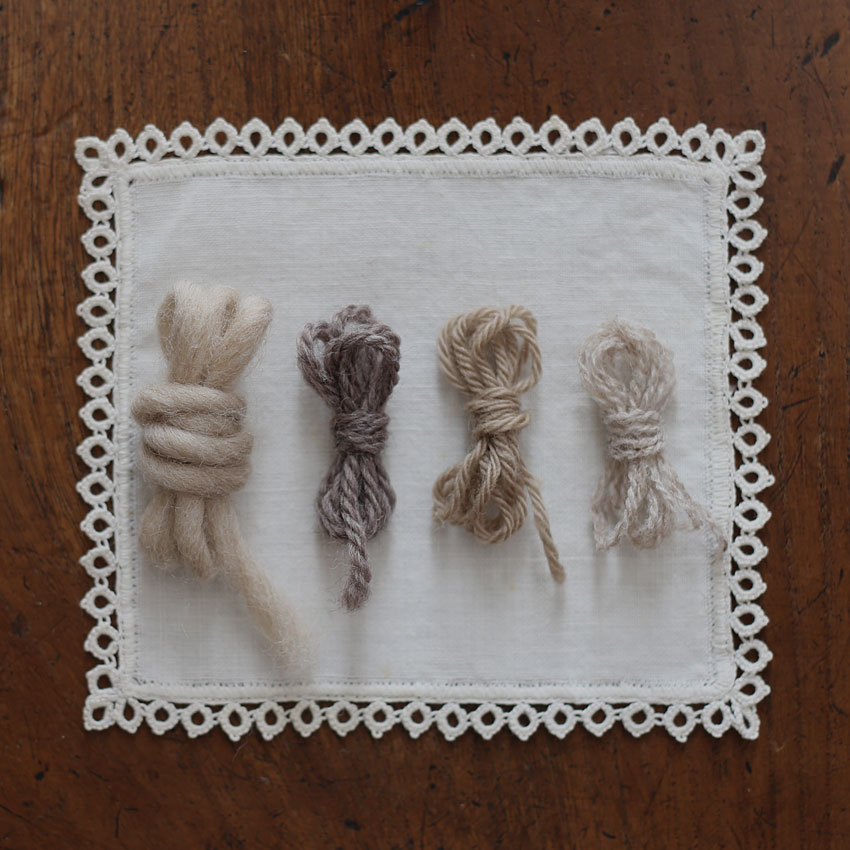
Starting with familiar names, "Roving" in the extra-thick category is a type of yarn called Roving yarn, which in Japan brings to mind Daruma's wool roving.
Even when looking at overseas yarns, if you look into Roving yarns, you will find a lot of loosely twisted, fluffy yarns (like Hamanaka's "Doo!" yarns).
In contrast, Rug yarn, which is also an extra thick yarn, is tightly twisted and looks very strong.
Even if they are similar in thickness, if the types are so different, it seems like it would make sense to classify them differently.
When I looked into the Afghan yarn in the extra thick category, I found a lot of colorful blankets from overseas.
"Sport" is also sometimes expressed as "Sport weight yarn."
In this way, by hearing about the type of thread, you can get a general idea of the thread's purpose and thickness.
Just as there are people who knit in their favorite genres, such as sock knitters and shawl knitters, when knitting socks it is easier to choose yarn if the yarn is classified as sock yarn.
Of course, other things can be knitted with sock yarn, but when you hear the term sock yarn, you probably imagine a medium-fine yarn.
I imagine that it's not just socks, but also Afghan (blanket) and Aran, and there are many other types.
In summary, even among threads of the same thickness, there are further classifications based on the type of thread.
As I continued researching, I gradually began to understand the differences between types of yarn.
In fact, this classification makes it easier to imagine a more concrete picture than the Japanese divisions such as medium-thin and medium-thick.
This time we looked at the American notation, but if you keep in mind the meaning of these notations, it will be very useful when choosing yarn from overseas.

