![かぎ針編みレシピ・無料編み図 Ronique [ロニーク]|基本の編み方から動画解説まで](https://ronique.jp/wp-content/uploads/2025/04/ronique_toplogo.webp)
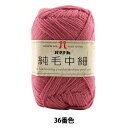
Using the information on the yarn's label, I tried to find yarn from a domestic manufacturer that was similar in thickness to the overseas yarn "Jamieson's Shetland Spindrift."
When comparing the grams and length of the yarn, it turned out that Hamanaka's "Medium-fine Pure Wool" seemed to be the closest in thickness.
As a sequel, I will actually measure the gauge and test it to see how reliable it is to choose thread based on ratio calculations.
[Can you trust ratio calculations?]
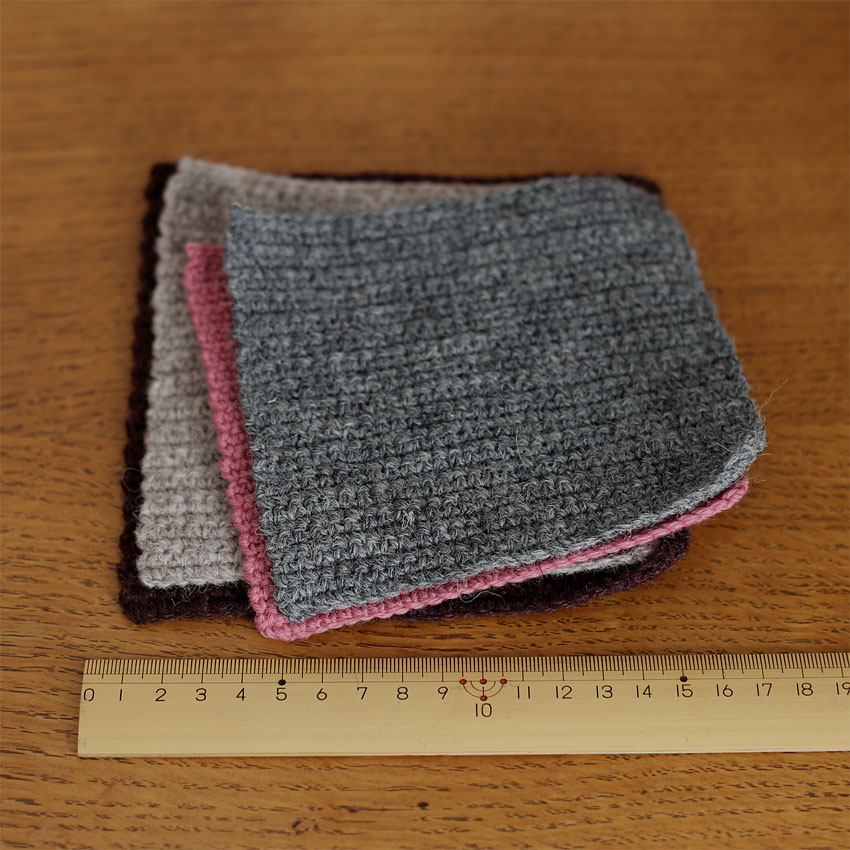
As with the numerical comparison, we measured the gauge using four types of yarn: Jamieson's and yarn from three domestic manufacturers.
This time I wanted to compare it with Jamieson's, so I knitted it with the same number of stitches and rows that would result in a square when knitted with Jamieson's.
For each yarn, I cast on 30 stitches and knitted 33 rows, and the results are as follows.
Jamieson's: 13cm long x 13.4cm wide
Pure wool medium fine: 12.2cm long x 13cm wide
British Fine: 12cm x 13cm
Shetland wool: 14.7cm length x 14.8cm width
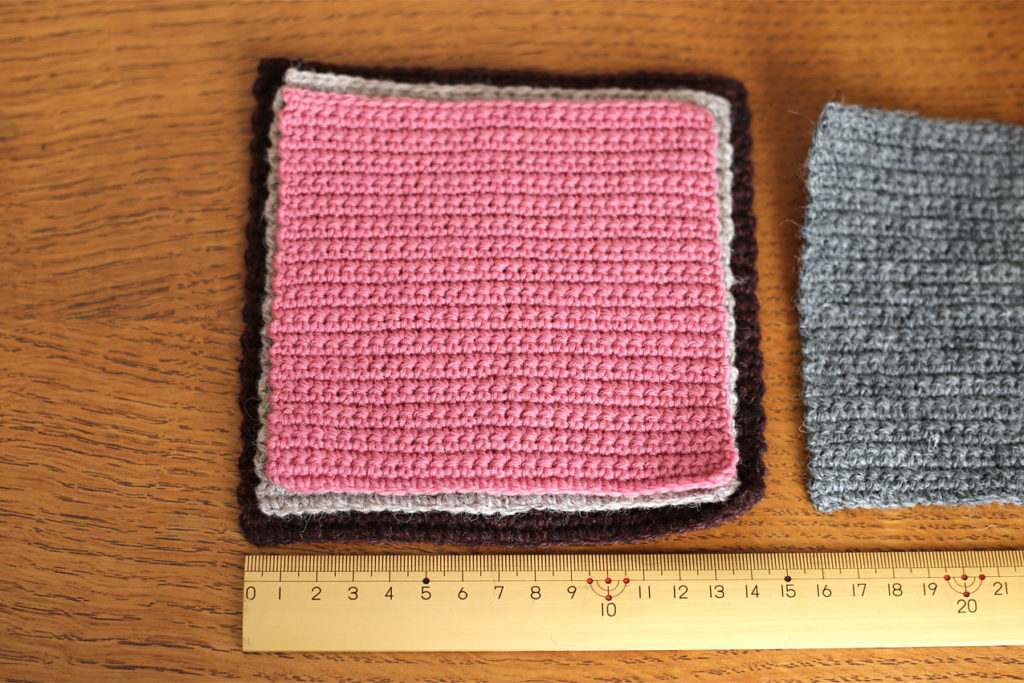
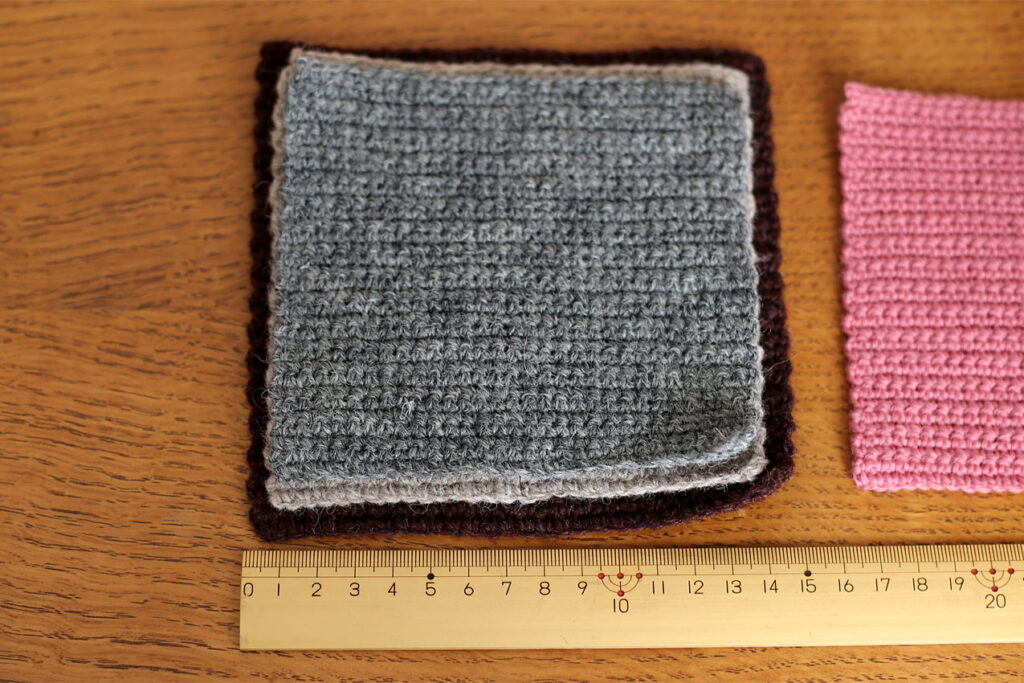
The subtle differences in millimeters likely come from the amount of effort used when knitting.
At first glance, I thought Shetland wool was similar, but when I actually knitted it, I found that it was thicker than Jamieson's.
I think the ratio calculation and the gauge result are a pretty good match.
It is a lot of work to gather together wool that seems to be of similar thickness and measure the gauge of several different types, so in cases like this, it seems more efficient to trust the ratio calculation and measure the gauge of wool other than ``Shetland wool'', which seems to be of a different thickness, to get a rough idea by calculating the ratio and then narrow it down.
[What to prioritize when choosing]
Since I took the time to knit it, here's a quick yarn review.
Jamieson's yarn has a soft, airy feel that reminds me of sheep. The yarns have a slightly tangled, catchy texture, which gives it a cute, wild feel.
Pure medium-fine wool yarn is soft, smooth, and very pleasant to the touch. The yarn is uniform in thickness throughout, making it easy to knit.
British Fine is a fluffy yarn that also has a strong sheep-like feel.Although it is thin, it has a moderate firmness and a rustic texture.
Shetland wool retains its rustic feel, but is uniform in thickness and has a plump, elastic texture, making it suitable for a variety of uses.
All four of these yarns are 100% wool.
In this test, the result was that "medium-fine pure wool" seemed to be the closest in thickness, but when actually choosing yarn, factors other than thickness, such as color and texture, are also important.
If thickness is your primary concern, then "pure wool medium-fine" might be the best choice, but if you want a yarn with a similar texture, then "British Fine" might be the best choice, as it has a similar sheep-like feel to Jamieson's.
【summary】
This time I compared it with yarn I had on hand, so it wasn't a perfect match, but if you search around the world for yarn, I'm sure you'll be able to find yarn that is closer in thickness to Jamieson's.
And actually, when I was choosing yarn from a domestic manufacturer for comparison this time, I initially thought that ``pure wool medium-fine'' was too fine and that I should choose something different.
As you can see, I can't rely on my visual sense (lol), so calculating ratios always helps me.
When shopping online, the weight of the thread and the length of the spool are usually listed (even if not, you can easily find it by searching for the thread name), so by doing the calculations like this, you can think of threads you know that are roughly the same thickness.
Please use this as a reference when you want to knit using a different yarn than the one used in the knitting pattern, or when you are unable to pick up and look at the yarn.