![かぎ針編みレシピ・無料編み図 Ronique [ロニーク]|基本の編み方から動画解説まで](https://ronique.jp/wp-content/uploads/2025/04/ronique_toplogo.webp)
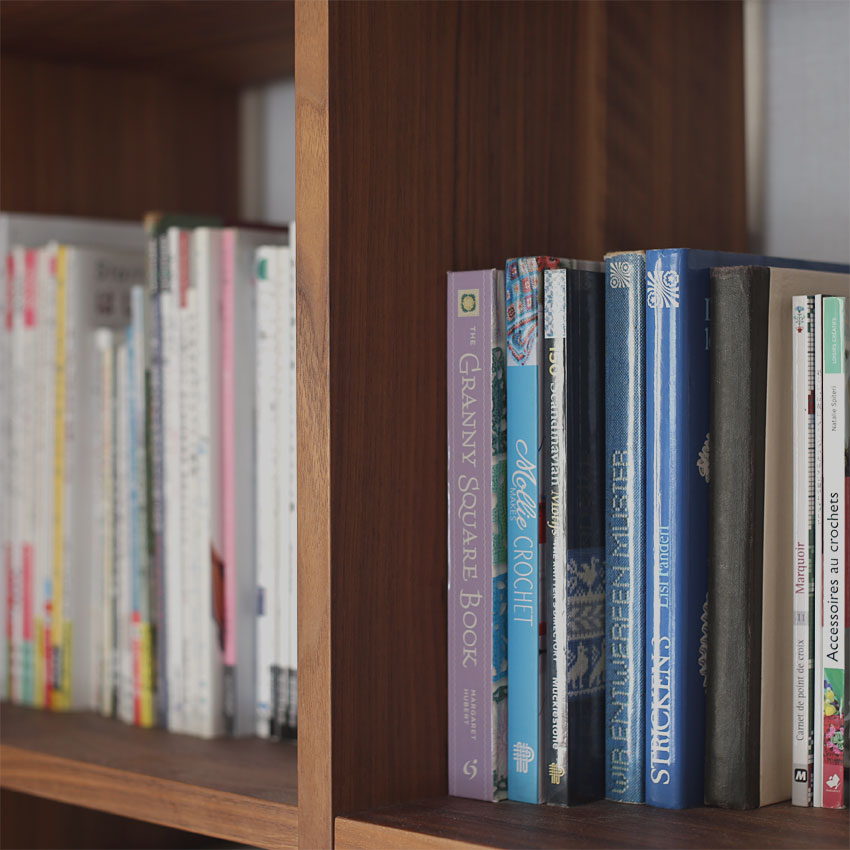
When it comes to crocheting, it is common in Japan to show how to crochet using a knitting pattern.
You can sometimes see knitting patterns in overseas recipes, but you can also often see patterns with knitting instructions in English.
Even though crocheting is something we're all familiar with, the amount of technical English terminology can make it seem intimidating at first.
However, if you can understand foreign English patterns, it seems that the enjoyment of crocheting will expand.
So, we've put together a list of terms that may be useful in understanding overseas recipes.
The books are presented in an order that takes into account the actual process, from preparing the yarn and crochet hooks to starting and finishing the knitting.
Even within the same English language, the way knitting instructions are written can differ depending on the country, but this is based on the notation used primarily in the United States.
Expressions vary depending on the recipe or book, so please use this as an example of how to write it in English.
Once you become familiar with the terms, you will find that they have been stored in your memory without you even realizing it, so at first it may be a good idea to just skim through the English text without thinking too deeply about it.
It would be great if you could come across a pattern that makes you want to try knitting it even after reading about it!
I hope to one day create a pattern in English... and I will look back at this page often.
Index
Yarn and tools
In overseas recipes, the thread used is sometimes written differently than in Japan, so it can be hard to know how thick the thread is.
It's easy to imagine what overseas yarn is like if you know the weight of a ball and the length of the spool, so let's start by looking at some commonly used units.
[Weight and length of yarn]
Yarn weight is measured in grams (g) and ounces (oz).
1 ounce = approximately 28 grams.
reference:A website that converts ounces to grams
The length of a spool of yarn is measured in meters (m) or yards (yd).
1 yard = approximately 0.9 meters.
reference:A website that allows you to convert yards to meters
If you are looking for yarn of a similar thickness, please refer to the separate page "How can I find threads that are similar in thickness?」「Continued: How do I find threads that are similar in thickness?Please also refer to "
[English expressions related to yarn]
- main color (MC): The main color. In knitting, it is the ground thread.
- contrasting color (CC): Literally translated, it means contrasting colors. In knitting terms, it is color-coordinated yarn.
[Crochet hook size]
The way crochet hook sizes are written also differs between Japan and overseas.
This is also a separate page:Crochet hook sizes in Japan and overseas"I hope this will be helpful to you.
[gauge]
Sometimes the gauge is listed in inches.
1 inch = approximately 2.5 centimeters.
reference:A website that converts inches to centimeters
[English expressions related to gauges]
- stitch (st): Eyes. Can be pluralized as stitches. Abbreviated as st(s).
- row: A row when knitting back and forth. The first row is written as "row 1".
- round (rnd): The row when making a loop stitch.
Beginning of knitting
We have summarized the expressions used in English patterns, explaining how to hold the crochet hook, cast on a stitch, and knit the first row.
[English expressions related to starting knitting]
- hold the hook: Hold a crochet hook
- hold the yarn: Hold the thread
- yarn over (yo): Thread the thread.
- yarn over hook (yoh): Thread the crochet hook.
- slip knot: The first loop you make before knitting the first chain.
- foundation chains:Cast the chain.
- foundation row: The first row of round knitting is sometimes expressed like this.
- foundation single crochet (fsc):
This method of casting on creates a finished look as if you had cast on a chain stitch while knitting a small stitch. The height of the cast on will also be about the same as when you knit a small stitch on a chain.Foundation Single Crochet" explains how to knit it. - foundation double crochet (fdc):
This method of casting on creates a finished look as if you had cast on a double crochet while working a chain. The height of the cast on will also be about the same as when you cast on a double crochet while working a chain. - multiples of X plus Y: A multiple of X plus Y (used when casting on a chain). For example, in a 3 stitches to 1 pattern, you would cast on a multiple of 3 + 1 stitch. Other variations include any multiple plus 3 (in this case, the first row is a double crochet, and the +3 is for the starting chain) and multiple of 2.
- work 6 sc in ring: Cast on the loop and knit 6 round stitches. The 6 stitches are just an example. This is often followed by an explanation such as "pull the free end of yarn to close the circle."
- join rnd with a sl st in first sc: Pull the needle through the first knit stitch to make a loop (at the end of the knit stitch loop, insert the needle into the starting stitch and make a pull stitch).
If this were a double crochet loop, you would say something like "join rnd with a sl st in 3rd ch of beg ch-3 (join rnd with a slip crochet in the 3rd stitch of the starting chain to make a loop)." - Front of chain:Front of the chain
- back of chain: The mountain behind the chain
- begin / beginning (beg): The first. For example, when crocheting a double crochet, the starting chain is written as "beg ch-3."
- turning chain (t-ch): A chain at the start of a round knitting stitch.
- 2nd ch from hook: The second chain stitch from the side closest to the crochet hook. For example, if you cast on a chain and then crochet all the way to the first row with a single crochet, after crocheting the starting chain, you would insert the needle into the second chain from the side closest to the crochet hook and crochet the single crochet. This expression is used in such cases. In English, you often see expressions such as "the nth chain from the crochet hook."
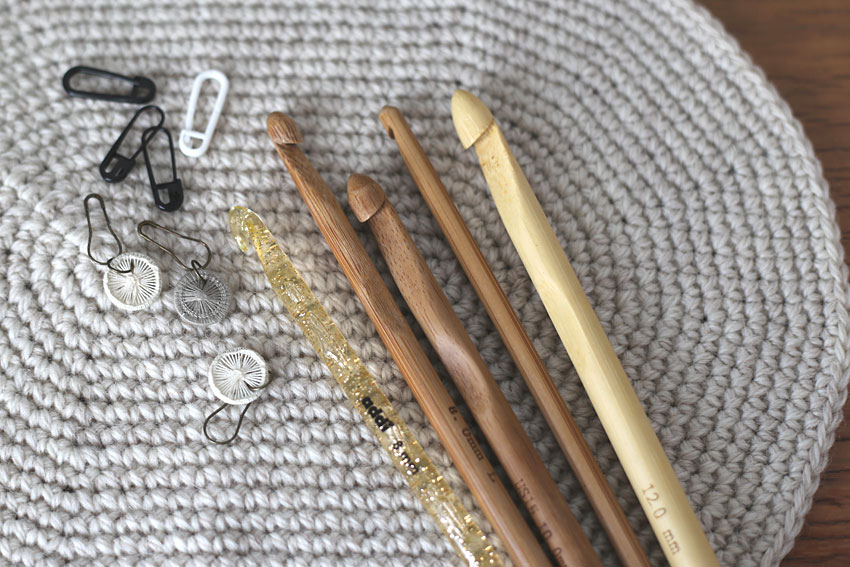
Explanation of various knitting techniques
Next, we have compiled some expressions that may be useful for understanding the English pattern as you proceed from the second row onwards. Expressions such as picking up stitches from the previous row and repeating stitches will appear.
[Knitting symbols and English expressions]
The English expression for the knitting method represented by Japanese knitting symbols is "Visual Reference: Japanese Crochet Symbols & English Terms" page for an explanation.
Japanese explanation of knitting symbolsWe use the same table as above, so you can compare it and check.
[English expressions related to knitting]
- chain space (ch-sp): The space created by the chains. Sometimes expressed as "space created by chains." This is the space where the crochet hook is placed when scooping up the previous chain into a bundle from the second row onwards.
- Right side (RS): The right side of the knitted piece. When knitting back and forth, if the chain tail is on the left side, you are looking at the right side of the knitted piece (if you are right-handed).
- Wrong Side (WS): The back of the knitted piece. When knitting back and forth, if the end of the yarn where you started is on the right side, you are looking at the back of the knitted piece (if you are right-handed).
- skip (sk): Skip. This expression is used when you skip a few stitches in the previous row and work into the stitch after that. For example, "skip first sc, dc in next sc."
- in each ch across: Work in each chain. For example, if you are working with a quarter stitch, you would say "sc in each ch across."
- increase (inc): Increased stitches.
- decrease (dec): Decreased.
- through back loop (tbl): Pick up only the one on the other side of the previous row.
- through front loop (tfl): Pick up only the one stitch in front of the previous row.
- front loop / front loop only (FL / FLO): Only the front eye in the first row.
- back loop / back loop only (BL / BLO):Only one on the other side of the eye in the previous row.
- front post (FP): Insert the needle from the front side of the knitted fabric and pull it up. This is a pull-up stitch.
- back post (BP): Insert the needle from the back of the knitted fabric and pull it up. This is a purl knitting operation.
[Knitting instructions using symbols]
- * : Repeat the knitting steps from the point marked with an asterisk according to the instructions.
- ( ): Work the stitches written in brackets into the indicated stitches. For example, "(dc, ch 2, dc) in next sc" means "In the next knit stitch (from the previous row), work 1 double crochet, 2 chains, 1 double crochet."
- [ ]: Repeat the stitch in brackets as many times as indicated.
Finished knitting
[English expressions related to finishing knitting]
- Fastening off: Pass the yarn through the loop on the crochet hook, tighten it, and cut the yarn.
- weaving in yarn: Thread the end of the thread through a darning needle and pass the thread through a few stitches of the knitted fabric to finish the thread.
Other miscellaneous items
There are many other expressions besides the ones we have picked up so far, but we hope that the following phrases, which are sometimes written as abbreviations, will also be useful.
[English expressions other than those mentioned above]
- alternate (alt): Alternative.
- approximately (approx):about.
- between (bet): Between.
- continue (cont):Continue.

