
Index
What's the difference between crochet and knitting?
Within the broad category of "knitting," there are even more specific knitting genres.
Crochet, knitting, afghan knitting, lace knitting, etc., use different tools to knit and the knitting method varies accordingly.
This time, we will focus on crochet and knitting, which have many enthusiasts, and compare them from various angles.
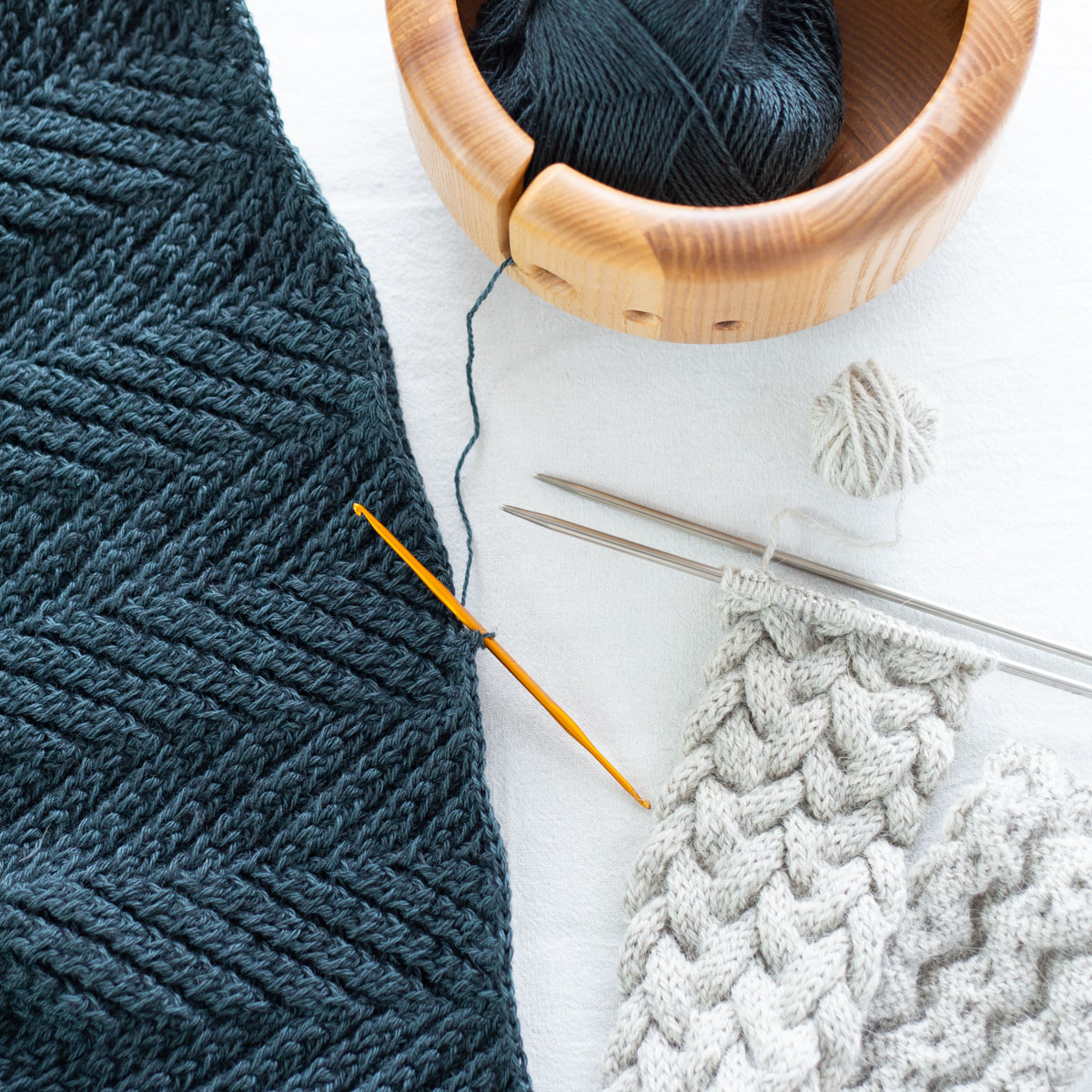
The first big difference between crocheting and knitting is the tools used.
Crochet is done using a single crochet hook with a hook at the end, whereas knitting is generally done using two knitting needles.
From here, we will take a deeper look at the differences between these two knitting techniques, which use different tools.
Comparison of crochet and knitting methods
Cast-on
In both crocheting and knitting with needles, it is common to make a cast-on before starting to knit.
In knitting with needles, the basic technique known as "finger cast-on" involves pulling out the yarn needed to make the cast-on in advance and then using the pulled-out yarn to make the stitch.
When crocheting, the most common techniques are to leave a small amount of thread at the end and knit the required number of chains, or to roll the end of the thread to make a loop and then knit stitches into it, called a "chain cast-on."
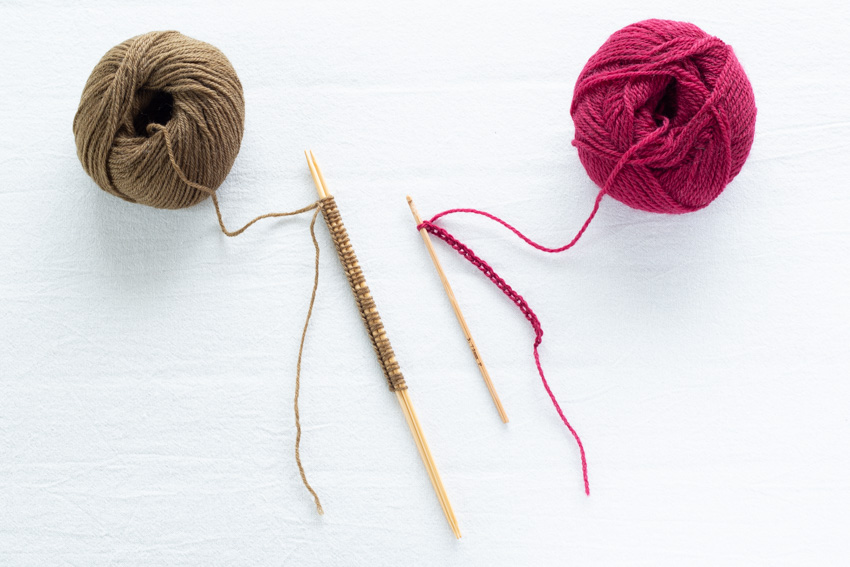
When you cast on a stitch, with knitting needles the entire cast on stitch is hooked onto the needle in a row, whereas with crochet only the last stitch loop is connected to the needle.
The different cast-on stitches give us a glimpse of the different knitting methods that will follow.
[Cast-on comparison]
Knitting with needles: All the loops of the cast-on are caught on the needles and lined up.
Crochet: Only the last loop of the cast-on stitch is on the needle.
How to knit
When knitting with needles, you insert another needle into the loop of the cast-on stitch that is already connected to the needle, thread the yarn through it, and continue knitting.
The completed loop is moved from the original needle to the other needle.
Once you've finished knitting, the needle that held the cast-on stitch will be empty, and the other needle will have all the stitches in place. Continue knitting by repeating this process.
The loop of the stitch will be on one of the needles until you finish knitting and close the stitches.
This can cause the loop to come off the needle and cause the stitch to fall off.
When crocheting, the cast-on stitch is the finished knitted piece.
The stitch will not come undone unless you remove the last loop of the stitch from the needle and pull the thread, so there is no concept of "dropping a stitch" as with knitting needles.
You will insert the needle into an already completed cast-on stitch and continue knitting, and where you insert the needle (which yarn you pick up) will affect the knitted fabric.
The cast-on loops in knitting are very easy to see, and it is clear how to insert the needle and knit.However, with crochet, although there are various ways to pick up the yarn, it can sometimes be difficult to know where to pick it up.
[Knitting method comparison]
Knitting with needles: You may drop a stitch until you finish knitting. The stitches caught on the needle are easy to see, and it is clear where to pick them up.
Crochet: Each stitch completes the knitted piece, so there is no need to worry about dropping a stitch. It can be difficult to know where to pick up the stitches.
How to untie
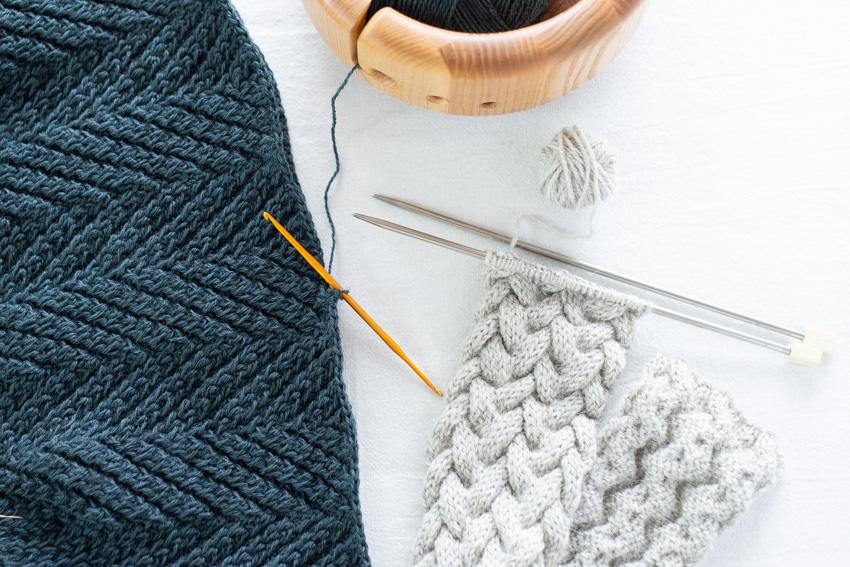
When knitting with needles, if you discover a mistake in a stitch you have already knitted, you simply move the stitches one by one onto another needle and continue undoing the stitches up to that point.
If the mistake is in a row far back, some people will remove all the stitches from the needles, pull the yarn, unravel several rows at once, and then pick up all the stitches again near the row where the mistake occurred, but this is not realistic for beginners.
Even if you undo one stitch at a time, the direction of the loop may change when you move it to the other needle, and if the pattern is complex, it may be quicker to start over from the beginning rather than undoing it and going back.
Additionally, repairing a dropped stitch is difficult for beginners, so recovering from an accident while knitting with needles is difficult and requires a certain level of experience and skill.
Crochet, on the other hand, is very easy to undo.
No skill is required to go back and start over; all you have to do is remove the last stitch loop from the hook and pull the yarn up to the point where you made a mistake.
It can be a shock to discover a mistake in an earlier row, but once you decide to re-knit, beginners and experts alike can easily undo it.
Crocheting can be seen as a knitting style that is easy to try, as you can undo and repair it yourself without the help of an experienced knitter.
[Comparison of untying methods]
- Knitting with needles: If you make a mistake, you need to move each stitch to another needle and undo the mistake. It is difficult to repair a missed stitch or a knitting mistake.
Crochet: If you make a mistake, it's easy to undo. Just pull the thread, unravel it in one go, and re-crochet it, so no skill is required.
Comparison of crocheted and knitted fabrics
Characteristics of knitted fabric
Knitted fabrics made with knitting needles are often relatively thin, soft, and stretchy.
In particular, the elastic knitting used on the collars and cuffs of sweaters is a highly elastic knitting method that is unique to knitting with needles.
Elastic knitting, also known as ribbing, is not only stretchy but also has a smart look.
Also, with stockinette stitch, the appearance of the knitted fabric remains the same whether you knit back and forth while turning the knitted fabric inside out or knit in the same direction in every row, which is an advantage when making projects.
Crocheted fabric tends to be thick and has a firm finish with little stretch.
Knit stitch is a popular knitting technique, and the fabric does not stretch easily, making it ideal for making bags and other items.
When crocheting, the look will never be the same if you crochet back and forth while turning the stitches over, as it will if you crochet in the same direction every row. However, the back of your crochet piece can sometimes develop an attractive texture, and it can be fun to use both sides of your crochet piece as the front of your project.
[Knitted fabric comparison]
Knitting with needles: Thin and highly stretchable. Stockinette stitches have the advantage that the appearance of the knitted fabric remains the same whether knitted back and forth or in the round.
Crochet: Thick and resistant to stretch. Crocheting back and in the round creates different looks and can create an attractive texture on the reverse side of the knit.
Trends in knitted works
Knitting with needles is characterized by the fact that many of the pieces make use of the stretchy nature of the knitted fabric.
In particular, the stretchy knit fabrics made using ribbing are a major attraction of knitting with needles, and knitted sweaters, knit hats, socks, etc. fit the body well, making them comfortable to wear and practical.
Additionally, shawls, which are often found as knitting patterns, are easy to use as they are made from thin fabrics that can only be produced with knitting needles, and the light finish is visually appealing.
The most commonly seen stockinette stitch fabric is the same as that found in ready-made knit items sold commercially, giving it a stylish impression, and one of the great things about knitting with needles is that it is easy to wear as an extension of everyday clothing.
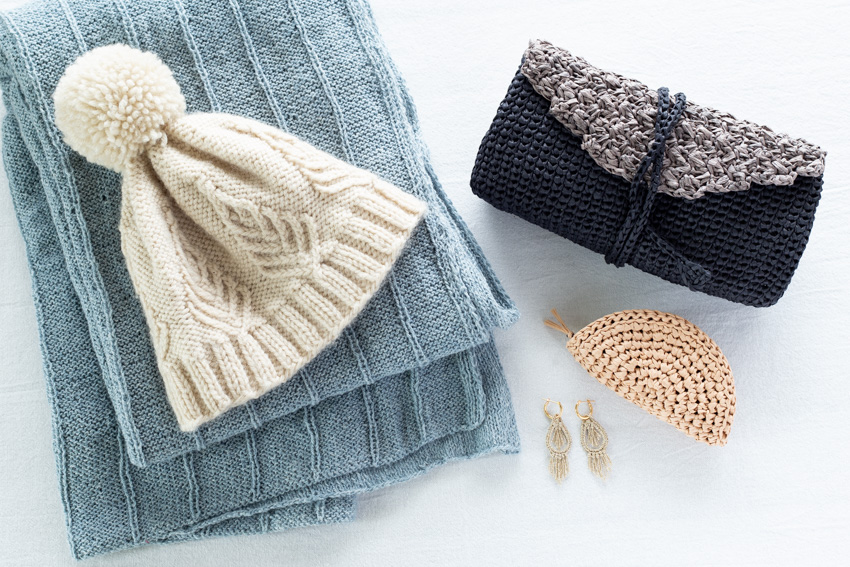
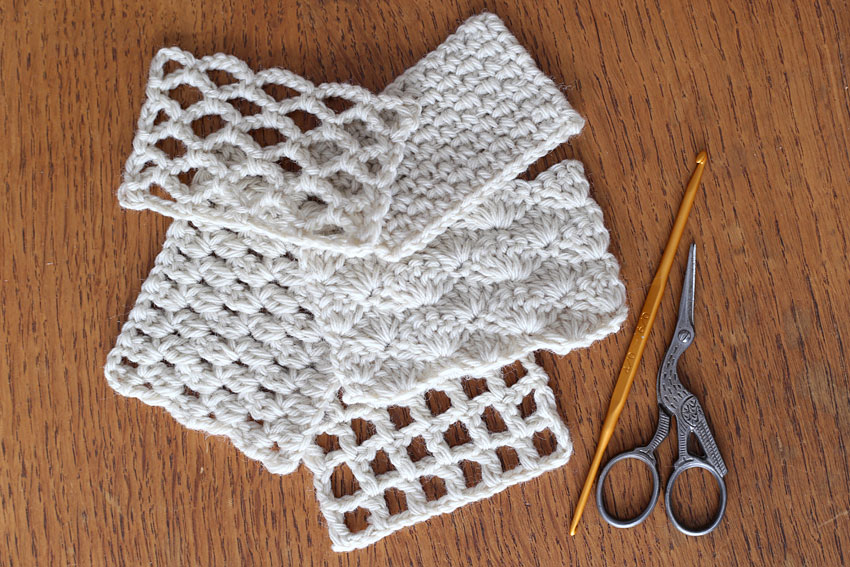
Crocheting does not require closing your eyes, so there is a great deal of freedom in creating your work, and you can see a wide range of works, from small to large.
It can be used to freely create a wide variety of knitted fabrics, from flat knitted fabrics to circles, cylinders, and even petal-like shapes, making it easy to knit small items such as corsages, accessories, and kitchen items.
The good qualities of crochet are also evident in bags that make use of the firm, non-stretchy knit fabric, and in amigurumi dolls that take advantage of the crochet's ability to easily knit three-dimensional shapes.
There are many lovely patterns for crocheted shawls and fashion accessories, and you can also enjoy the nostalgic atmosphere reminiscent of bohemian and folklore with motif-connecting and grid-knit lace patterns.
[Comparison of works to be knitted]
Knitting: There are many fashion items such as clothing, shawls, and socks that make use of thin, stretchy knit fabrics. They are comfortable to wear and have a stylish finish.
Crochet: Taking advantage of the firm knitting and ease of three-dimensional knitting, you can knit a wide range of items such as bags, stuffed toys, and fashion accessories. The appeal is that you can make a wide variety of items.
Comparison of yarns used for crochet and knitting
Amount of thread used
As you can tell from the thinness of the knitted fabric, knitting with needles allows you to create larger fabrics using a relatively small amount of yarn.
From this perspective, it is easy to knit large items such as sweaters.
Crocheting, on the other hand, produces thicker, more sturdy knit fabric and therefore requires more yarn.
Therefore, when using threads made from heavy materials such as cotton or linen, you may need to take care not to make the finished size too large so that the project does not become too heavy.
The amount of yarn used will vary greatly depending on the knitting pattern and design, but as a simple example, if you knit the same size pattern using stockinette stitch with knitting needles and then knitting with a crochet hook, the knitting will use more yarn.
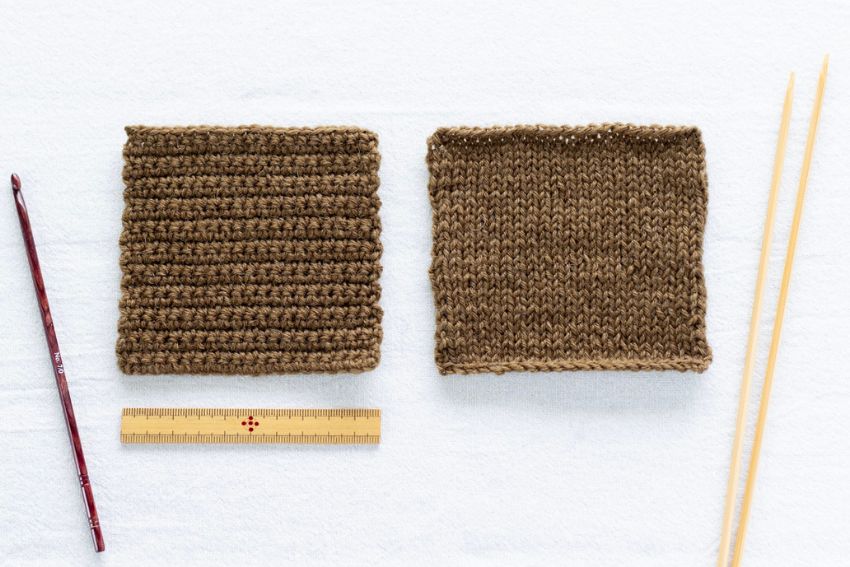
As an experiment, I used the same yarn to knit a 10cm square piece using stockinette stitch and knit stitch.
The amount of yarn used was 4g (approximately 12.8m) for stockinette stitch and 5.8g (approximately 18.56m) for knit stitch.
This comparison shows that crocheting uses 45% more yarn than knitting.
[Thread usage comparison]
- Knitting with needles: Since the knitted fabric is thin, less yarn is used.
Crochet: Crochet creates thicker fabrics, so you need more yarn. In some cases, you need 45% more yarn than knitting with knitting needles.
Type of thread used
From what we have seen so far, we can see that knitting with needles is a perfect match for wearable items such as clothing.
Knitted sweaters and hats are items that are often worn during the chilly season.
Elastic and soft winter yarns such as wool and alpaca are very easy to knit with knitting needles, and looking at the works out there, it seems that wool is the most common yarn used for knitting with knitting needles.
Of course, there are also summer knits, and soft cotton yarns are often seen in knitting projects.
However, stiff, stiff linen yarns tend to be slippery when knitting with knitting needles, and can be more difficult to knit with than wool, so you need to be careful not to drop stitches while knitting.
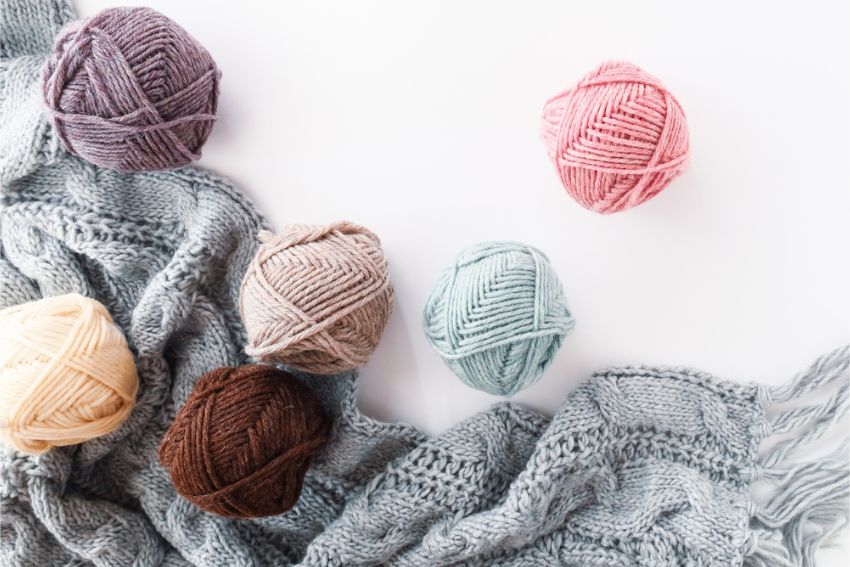
Crocheting tends to be relatively easy to do with any yarn, thanks to the hook at the end of the needle and the lack of worry about dropping stitches.
Basically, anything that is in string form can be knitted, whether it's thin, soft yarn, hard hemp cord, or even unusual materials like packing tape.
Depending on the thickness and hardness of the yarn, it may not be suitable for all types of knitting, so it is important to use yarn that you can knit with comfortably, but when it comes to knitting with a crochet hook, the range of yarns that can be used is extremely wide.
Crocheting allows you to create any type of knitted fabric you like and uses a variety of yarns, making it easy to add individuality to your work and offering the joy of expressing your own unique creativity.
[Comparison of types of thread used]
Knitting with needles: Items to be worn are often knitted, and soft, elastic yarns are easier to knit with, so wool is the mainstream.
Crochet: Crochet is relatively versatile and can be comfortably knitted with a wide range of yarns. Combined with the flexibility of knitting, it is easy to create unique pieces using a variety of materials.
Interruptibility and portability of crochet and knitting
interruption
When knitting with needles, the stitches are caught on the needles, so if you stop knitting in the middle of a row, you need to be careful not to let the stitches loosen or change tension before and after the stop.
Also, when knitting complex patterns, you need to be careful about where and when to stop so that you don't make any mistakes when you stop.
If you need to stop, it is a good idea to attach a stopper to the tip of the needle to prevent the stitch from coming off the needle.
Crocheting is easier to stop than knitting with needles because the knitted piece is completed one stitch at a time. However, when knitting a complex pattern, it is better to stop at a good time to avoid making mistakes.
While you are taking a break, it is a good idea to pull out the loop of the last stitch a little longer or secure it with a stitch marker to prevent the thread from being pulled unexpectedly and coming undone.
[Interruption comparison]
- Knitting with needles: Be careful not to let the stitches loosen or the tension change when you stop. Be careful about when to stop to avoid making knitting mistakes.
- Crocheting: It's easy to stop, but when you're knitting a complex pattern, it's better to choose a good time to stop so the process goes more smoothly.
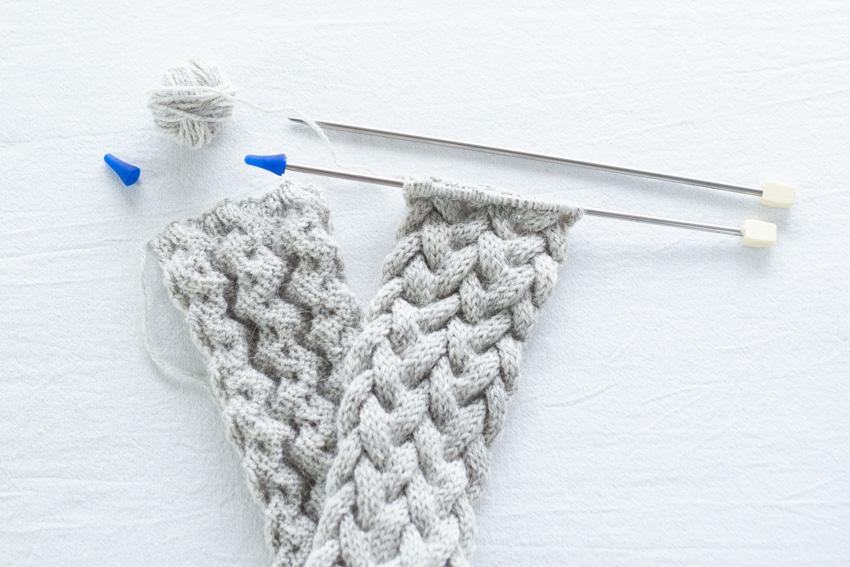
portability
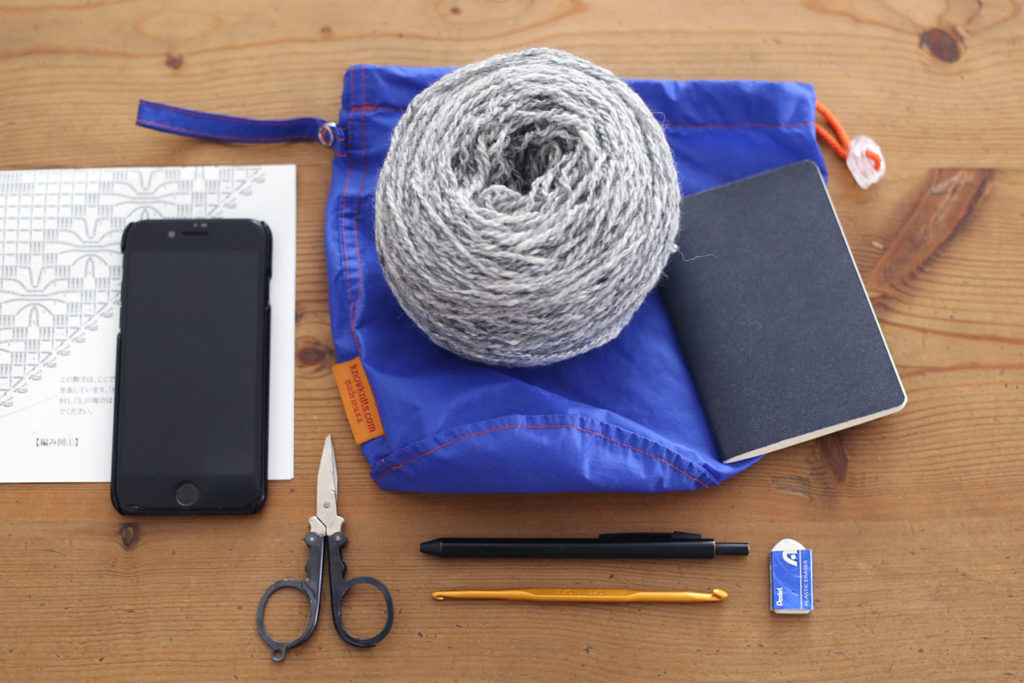
Knitting with straight needles often produces larger pieces such as knitwear and shawls, and if you use long needles they may be bulky to carry around, but if you use flexible needles like those used for circular knitting, you can roll them up and make them compact, which is convenient.
A stopper must be attached to prevent the needle from moving and coming off the stitch while in transit.
Crochet is easy to carry around because the hooks themselves are short and crocheted pieces often contain small items.
It's easy to stop knitting, so it's perfect for carrying a project you've started and continuing to knit a little at a time in your spare time. In particular, projects that follow the same pattern every row are recommended for mobile knitting.
[Portability comparison]
Knitting needles: Circular needles are compact and easy to carry. They require a stopper to prevent the stitches from coming off.
Crochet: Crochet hooks are short and there are many small projects that can be made, making them easy to carry around. They are also easy to interrupt, making them suitable for mobile knitting.
Review and Summary
Looking back at the differences between crochet and knitting that we have compared so far, we have summarized them in the table below.
| Crochet | knitting needles | |
| Cast-on | Only the last loop of the cast-on stitch is on the needle. | All the loops of the cast-on stitch are caught on the knitting needle and lined up. |
| How to knit | Each stitch completes the knitted piece, so there is no need to worry about dropping a stitch. It can be difficult to know where to pick up the stitches. | There is a chance that you may drop a stitch until you have completed the knitting. The stitches caught on the needle are easy to see, and it is clear where to pick them up. |
| How to untie | If you make a mistake, it's easy to undo. Just pull the yarn, unravel it in one go, and re-knit it, so no skill is required. | Repairing is difficult. If you make a mistake, you have to move each stitch to another needle and undo the mistake. |
| knitted fabric | It is thick and does not stretch easily. The appearance of knitted fabric differs between round and round knitting, and the reverse side of the knitted fabric can sometimes be more attractive. | It is thin and highly stretchable. The advantage of stockinette stitch is that the appearance of the knitted fabric remains the same whether it is knitted back and forth or in the round. |
| Woven works | Taking advantage of the firm knitting and ease of three-dimensional knitting, you can knit a wide range of items such as bags, stuffed toys, and fashion accessories. | The brand offers a wide range of fashion items, including clothing, shawls, socks, and more, all made from lightweight, stretchy knit fabrics. They are comfortable to wear and have a stylish finish. |
| Amount of thread used | Since it is a thick knitted fabric, a lot of yarn is used. | Since the knitted fabric is thin, less yarn is used. |
| Type of thread used | A wide range of yarns can be knitted comfortably. The high degree of freedom in knitting and the variety of materials make it easy to create unique pieces. | Since most knitting involves items to be worn, soft and elastic yarns are easier to knit with, so wool is the most popular. |
| interruption | It's easy to stop, but when you're knitting a complex pattern, it's better to find a good time to stop so things go more smoothly. | Be careful not to let the stitches loosen or the tension change when you stop. Also, pay attention to the timing of your stops to avoid making mistakes when knitting. |
| portability | The crochet hooks are short and many small projects are easy to carry. They are also suitable for mobile knitting as they are easy to interrupt. | Circular needles are compact and easy to carry. They need a stopper to prevent the stitches from coming off. |
lastly
The above is a thorough comparison of crochet and knitting with needles from my perspective as someone who is deeply immersed in crochet.
Although I now do a lot of crocheting, the first thing I ever did was knit with needles, which my mother taught me.
When I knitted with knitting needles, I always had to rely on my mother to help me out when I dropped a stitch or the number of stitches was off, so I also had the misconception that I couldn't do it myself and missed the opportunity to properly learn, and I remain a beginner to this day.
This thorough comparison includes her own experiences of what she finds difficult about knitting with needles, her admiration for knitting with needles, and the points and charms that make crocheting easy to get into.
The knitting method may be a bit biased towards crochet, but please use it as a personal report.
I understand the joy of knitting with needles, so I would like to try it out in depth someday.
Crochet and knitting each have their own unique charms.
Both are knitting activities that you can enjoy without thinking too much.
If you have never tried either or both, please give them a try if you have the opportunity.
Introducing the Top 3 Most Popular Patterns | Ronique Store
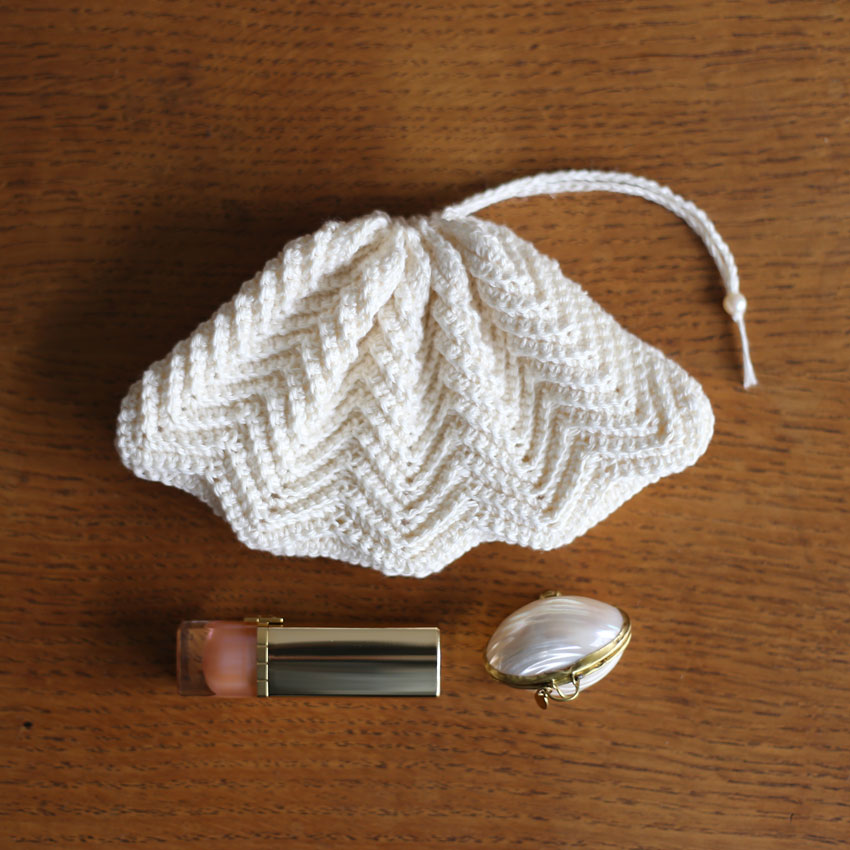
[No.1] Seashell Pouch
This has been our best-selling product since its release, consistently being our most popular item.
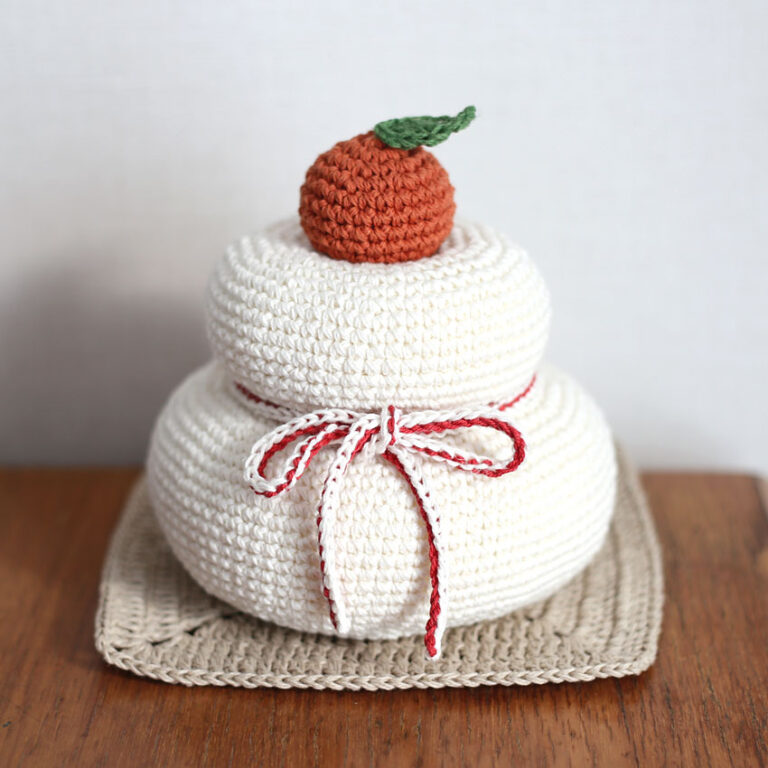
[No.2] Assembled Kagami-Mochi
With its distinctive construction, this seasonal favorite is as fun to crochet as it is to use.
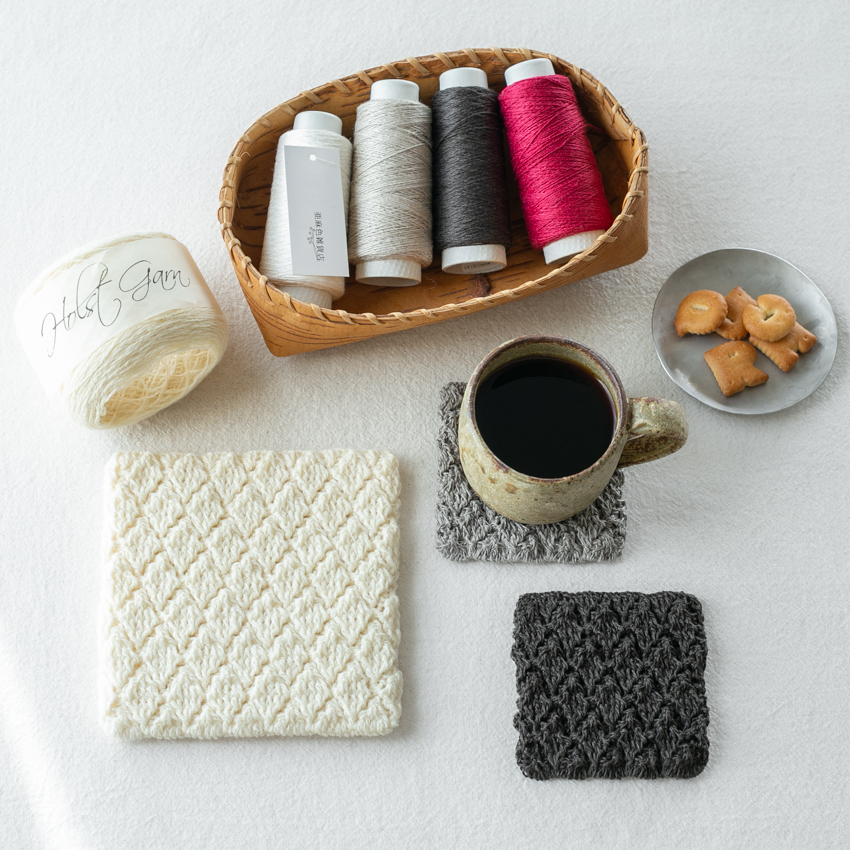
[No.3] Mindful Mat
This popular product is easy to use for everyday wear, and its three-dimensional texture really stands out.

