
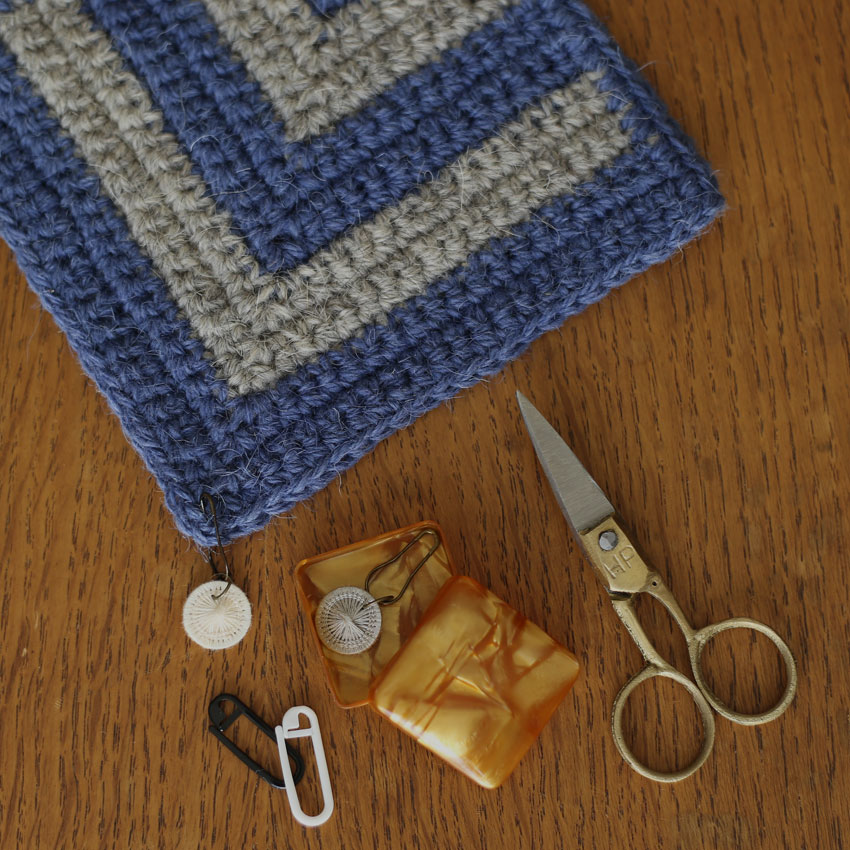
We will focus on a tool that knitters may have, but beginners may not know if it is an essential item: the stitch marker.
We compared the usability of several types of stitch markers, taking into account the situations in which they are useful.
Index
Do I need stitch markers?
If you're just starting to crochet, you might be wondering: are stitch markers essential crochet tools?
There was a time when I had no need for stitch markers, so much so that I began to wonder the same thing.
You can also follow the old-fashioned idea of pinching or tying the end of the thread to make it a marker.
However, there were many times when I thought it would be a useful tool to have.
So, first, I'd like to introduce a situation where I felt that stitch markers were necessary.
Aids in counting stitches
When knitting a large piece, if you need to chain together 150 stitches, or knit two 200-stitch thread cords (to ensure they are the same length), the number of stitches you need to count can be enormous.
I once had the disappointing experience of counting up to 145 stitches out of 150 and then losing track.
In such cases, if you place a stitch marker at the convenient round number of 100 stitches, you will only need to recount at 50 stitches.
It can be quite a hassle to tie the end of the thread to a chain to mark the 150 stitches, so a stitch marker that can be used quickly in situations like this is a great tool to have!
Measures to prevent oversight and passing
This also applies to slightly larger pieces, such as pieces with a large number of stitches in one row but only four places where stitches are increased.
Don't you want to have to count the number of stitches until the next increase while knitting?
And because you can see where you've increased your stitches, you can just knit up to the next increase without counting the number of stitches!
However, when you actually knit, it can be surprisingly difficult to see where the next increase is, and you may end up missing it and passing it over.
Stitch markers come in handy in situations like these.
If you can find the markers, you won't miss the increased area and pass it by.
Then, as you progress through the steps, you can quickly re-marker the increased points on nearby steps to prevent overlooking markers that are far away.
Even in situations like this, it's nice to have something that's easy to put on and take off.
Types of stitch markers and how to use them
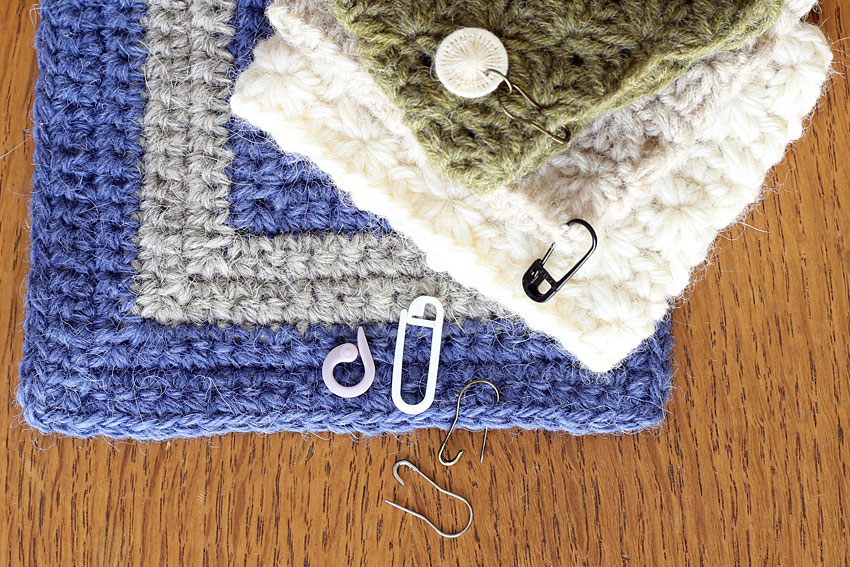
There are two types of stitch markers:
One is a safety pin-type stitch marker.
A normal safety pin has a round loop on the opposite side of the closure, but a stitch marker does not have this.
The other type is a stitch marker, which you attach by threading the yarn through the gap. You often see these round, compact ones.
How to use stitch markers [Psychological]
The safety pin design closes completely, so you don't have to worry about it falling off while you're knitting. It also has a snag-free design, so it's very secure.
Even the type that fits through a gap is unlikely to fall out, but there is a subconscious feeling that if there is a gap, it cannot be said with certainty that it will "absolutely" not fall out.
So psychologically, safety pin stitch markers seem to have an advantage.
How to use the stitch marker [Operation]
The operation of a safety pin stitch marker can be broken down into two steps: 1) insert the tip of the pin into the knitted fabric, and 2) retract the tip of the pin and lock it in place.
In contrast, with a stitch marker that passes through a gap, the only step is to pass the thread through the gap in the marker.
Another great benefit is that it can be attached and removed with one hand.
Therefore, in terms of operation, the stitch marker that passes through the gap seems to be the winner.
How to use stitch markers [storage]
The type that goes through a gap is thin and small, while the safety pin type has a thicker locking part and is longer, so the former is more compact.
The safety pin type can be connected together to form a single unit, making it convenient for quickly putting them all together in a toolbox or pouch. Connecting the types that fit through gaps together is not practical, so they end up scattering.
In terms of storage, the pros and cons will likely depend on how you want to store it.
Easy to use points
So, which stitch markers are actually easy to use?
With the basic premise that preferences vary from person to person, I will share my impressions of using it.
The biggest difference I noticed in usability was the degree to which the marker opens when attaching and detaching the thread. The wider the opening, the less stress there is when attaching and detaching the thread.
When tools become a hassle to use, you end up using them less and less.
It may seem obvious, but the problem was whether it was easy to put on and take off.
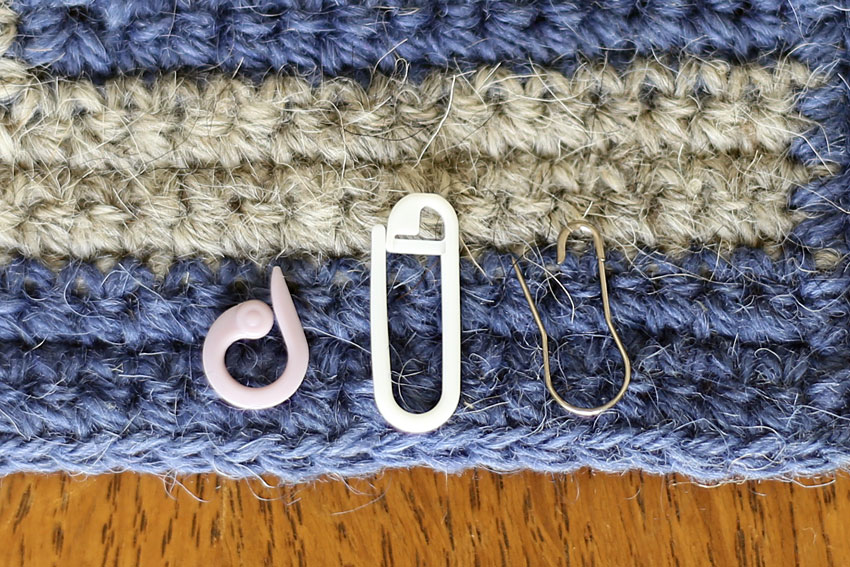
My favorite is the Daruma-shaped knitting pin, the type on the right in the image above.
The needles are thin and easy to thread through the fabric.
Although the downside of this pin is that it is not very noticeable due to its thinness, I prioritize ease of attachment and removal, and this is the pin I use most often.
This is because I often use stitch markers for large projects with many stitches, and if the marker comes off while I'm knitting, it can cause a lot of damage!
For this reason, I often use this because I want the peace of mind that the knitted fabric will not come off even if I move it around.
When making small projects, for example, when using stitch markers to avoid missing stitches, the marker on the left is convenient because you will need to change it frequently.
Being able to put it on and take it off with one hand is really convenient!
I also like the marker in the middle because it's cute and pop, and it's an item that really gets me in the crocheter mood (this is important).
It's a collectible piece that you'll be happy to own.
Things to consider when choosing a stitch marker
This information is aimed at beginners to crocheting, but here is the only thing to keep in mind when choosing markers.
There are several things similar to stitch markers, and you may have heard of names with similar meanings, such as stitch count rings and row count markers.
Be careful, some of these markers can only be used with knitting needles.
This is called a "stitch count ring," which is a ring-shaped marker like the one shown in the image below.
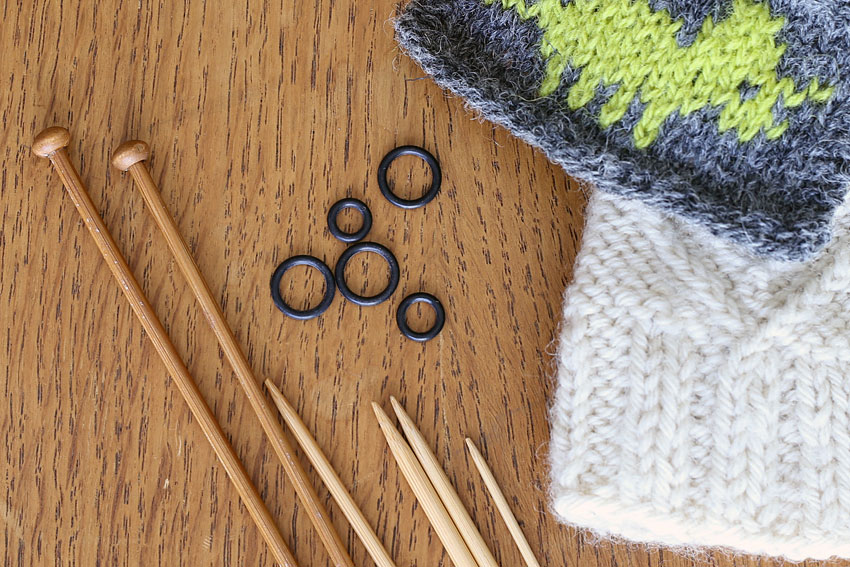
The loop is completely closed, so if you use this to crochet, you won't be able to remove the ring later.
For crochet, be sure to choose markers with gaps or that can be opened and closed.
Just be careful about this and you'll be fine!
Extra Edition
Stitch marker substitute
When you don't have a stitch marker on hand, but you want to mark a spot, you'll want to find something to use instead.
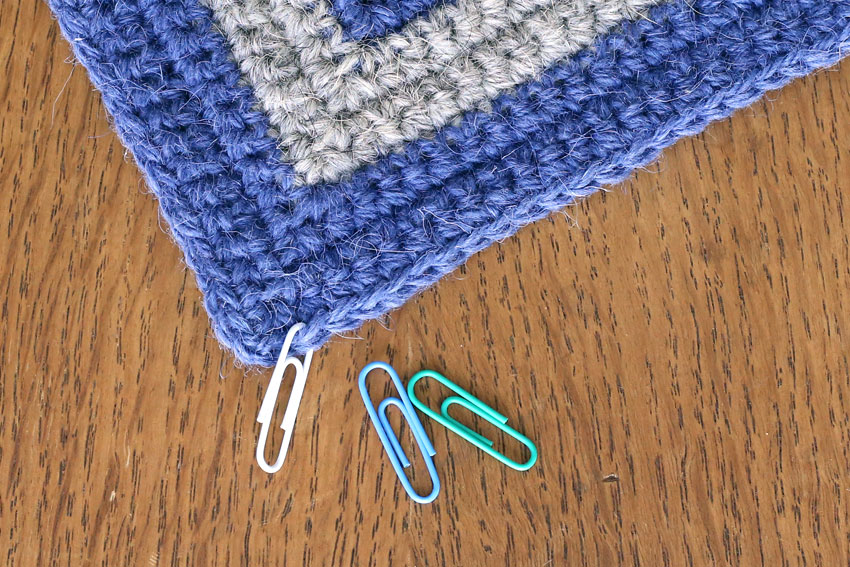
I mentioned clamping the end of the thread at the beginning of the page, but another option is to use a paper clip.
It is difficult to attach and remove, so it can be a bit of a hassle if you need to move the marker frequently, but it can serve as an alternative to mark a fixed position.
The other similar item is a regular safety pin.
Be careful not to get the thread caught in the round loop of the safety pin.
Making your own original stitch markers
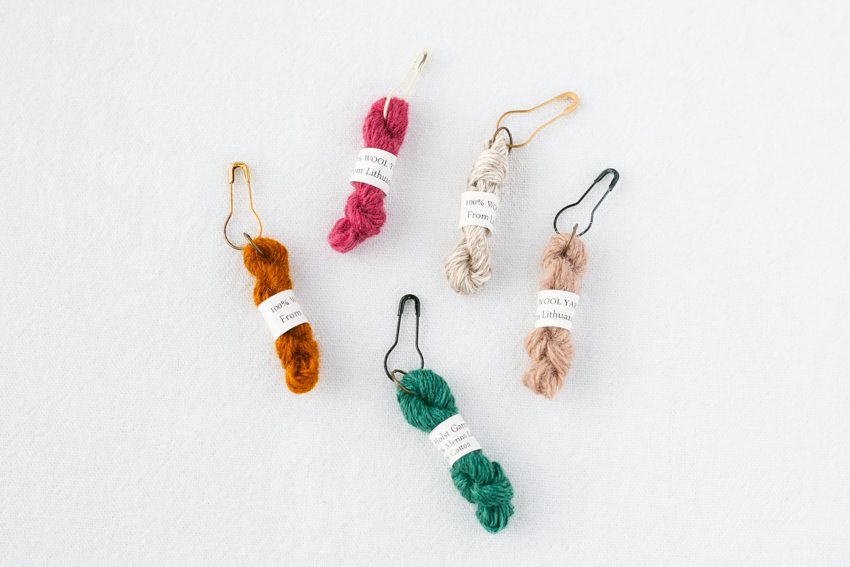
Pin-type stitch markers allow you to attach charms to create your own original markers.
If the charm is too heavy it will pull on the knitted fabric, so it is recommended to use a lighter charm.
Here, the yarn is twisted to make a small skein, which is then attached with a loop and threaded through a stitch marker.
Choose a stitch marker that stands out against the color of your knitted fabric to make it stand out.
If you want to have fun making handmade crochet tools, how about trying these crafts?
summary
We've taken a closer look at stitch markers from several perspectives, including in what situations they are used in crocheting and whether there are differences in usability depending on the type of marker.
While it's unknown how often it will be used, there's no doubt that it's a useful tool to have in case of an emergency.
If you are ever looking to buy new stitch markers, please use this as a reference!


