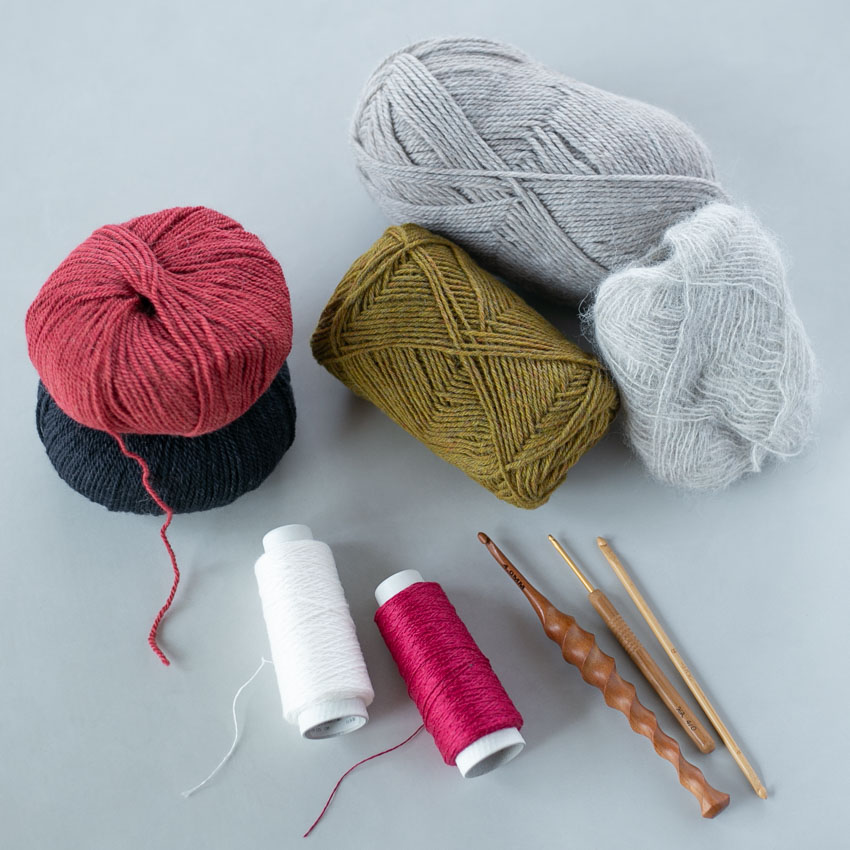
When you're crocheting, you often encounter situations where you can't get the yarn specified for the pattern.
The yarn specified in the pattern has been discontinued, or it's not sold at nearby stores.
In such cases, you'll need to look for an alternative yarn.
Substitute yarn refers to yarn that is similar in thickness and properties to the specified yarn and is used in place of it.
If you know the tricks to choosing the right thread, you can enjoy creating projects even without the specified thread.
This article delves deep into how to find alternative yarns for crochet!
We'll guide you through everything from comparing different types of yarn to calculating the required number of balls and using AI to find the right yarn.
Index
When do you need substitute yarn when crocheting?
The reasons for looking for alternative yarn vary from person to person.
- The specified thread has been discontinued.
- Not available at nearby stores or online.
- The pattern is from overseas and specifies yarn that cannot be purchased in Japan.
- I don't have a favorite color.
- I want to keep the budget down and use the yarn I already have.
- I want to change the material (e.g., wool to cotton).
Being able to choose alternative yarns greatly expands the range of projects you can knit.
You won't have to give up on knitting patterns from old books or patterns from overseas just because of yarn selection.
Before looking for an alternative yarn: Check the information on the specified yarn.
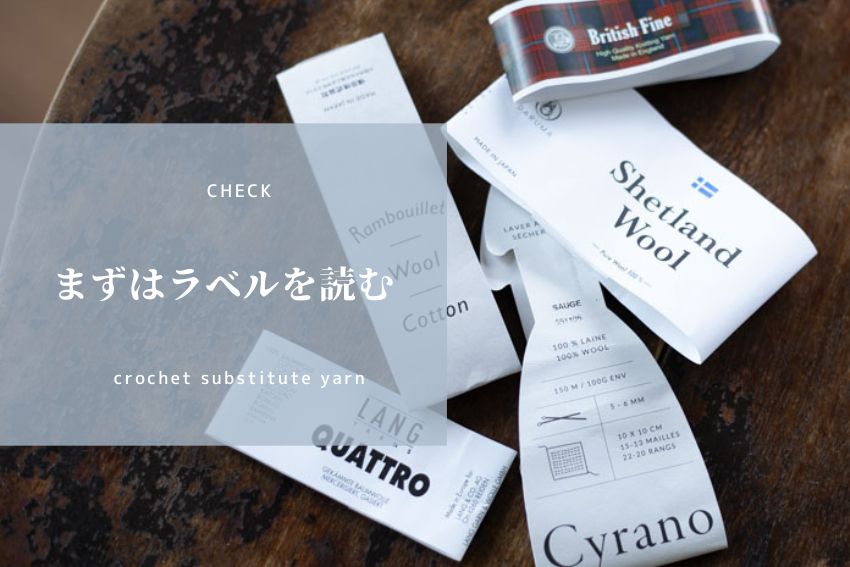
First, gather the information about the yarn specified in the knitting pattern.
Information not included in the knitting pattern can often be found by searching for the yarn name on the manufacturer's website or by looking at images of the yarn label.
| Confirm | Examples of notation |
|---|---|
| Thread thickness | Medium weight, Medium weight, Extra thick |
| Weight and length of one ball | 100g/approx. 360m, 40g/approx. 80m, 40g/approx. 50m |
| Standard gauge (10cm square) | Double crochet 24 stitches 11 rows, double crochet 20 stitches 9 rows, double crochet 13 stitches 6 rows |
| Compatible needles | 4/0 needle, 6/0 needle, 8/0 needle |
| material | 70% cotton, 30% linen; 50% mohair, 50% wool; 100% wool |
| shape of thread | Straight, mohair, loop |
| Usage amount | 3 balls (320g), 10 balls (400g) |
What's especially important is the "weight and length of each ball." Since the thickness (e.g., medium thickness) varies from manufacturer to manufacturer, it's best to compare them by their numbers.
Tips for choosing alternative yarn for crochet
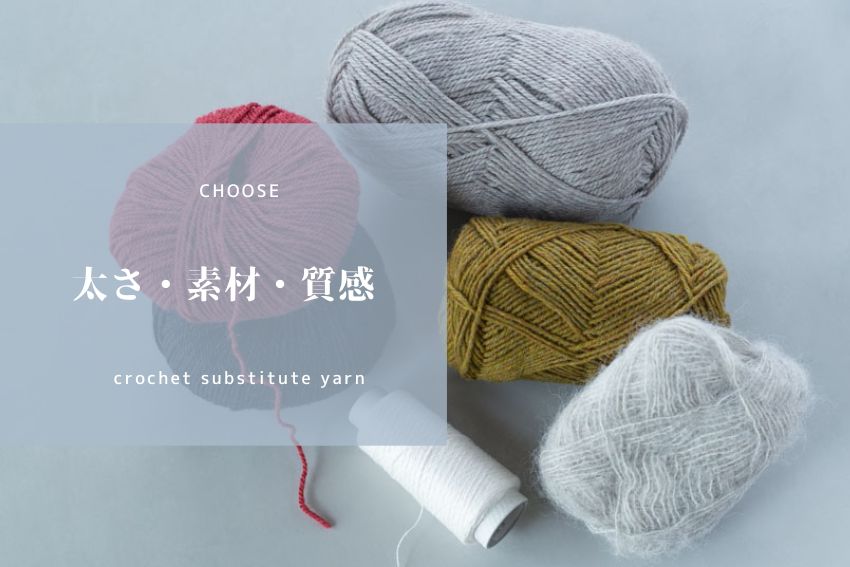
When choosing a substitute yarn, compare the following five points in order. The higher up the point, the greater the impact on the final result.
1. Choose items with similar lengths per gram.
The best way to compare the thickness of threads is by the length per gram. For the same weight, longer threads are thinner, and shorter threads are thicker.
The calculation is "length of one ball (m) ÷ weight of one ball (g)".
| 糸 | Weight and length of one ball | Length per gram |
|---|---|---|
| Specified thread | 40g/approx. 80m | 2.0m |
| Candidate thread A | 50g/approx. 105m | 2.1m |
| Candidate thread B | 40g/approx. 120m | 3.0m |
In this example, candidate yarn A is close in thickness to the specified yarn.
Yarn option B is quite thin, so if you knit with it as is, the finished product will be small.
If the difference is around 10%, it can often be adjusted by changing the needle size.
2. Compare the standard gauge with the compatible stylus.
We also compare the standard gauge and compatible stylus written on the label.
In Japan, yarn labels often only show the gauge for knitting with knitting needles.
Even when crocheting, the gauge and needle size of knitting needles serve as a guide to the thickness of the yarn.
If the gauge and needle size of the specified yarn and the substitute yarn are similar, you can assume that the thickness is also similar.
3. Gather the materials
Even if the thickness is the same, the finished product will differ depending on the material.
- elasticityWool results in a soft and bouncy knit fabric, while cotton and linen result in a firmer, more structured knit fabric.
- weightThe weight of the fabric increases in the order of acrylic, wool, and cotton/linen; therefore, the finished weight will vary even for the same piece.
- Appearance and feel:The shine, color, texture, and how easily pilling occurs will all change.
- MaintenanceCotton, linen, and acrylic are water-resistant and easy to wash. Linen becomes softer and its texture changes significantly when wet. Wool and rayon are sensitive to water and prone to shrinking, so care should be taken.
When changing materials, it's reassuring to imagine "how the artwork will change" before making your selection.
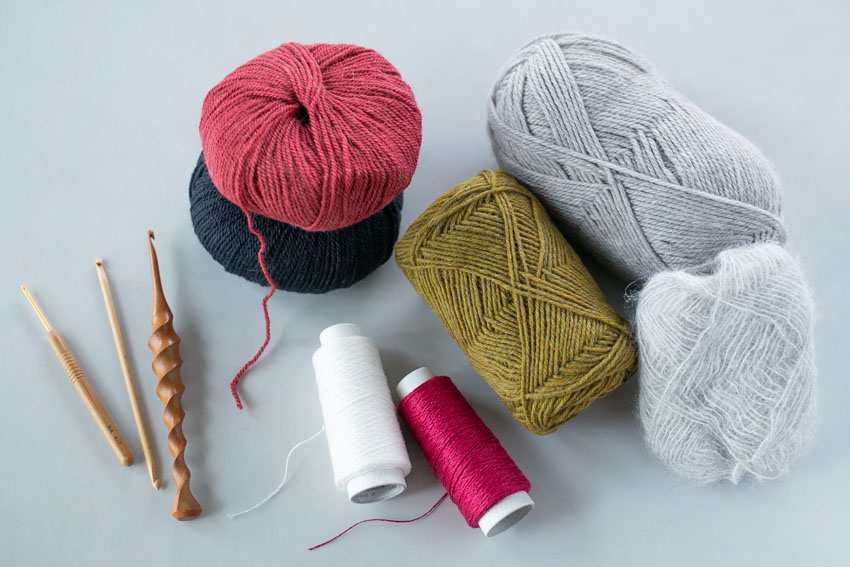
4. Make sure the threads are the same shape.
The shape of the thread affects how the pattern appears and the overall feel of the finished piece.
When choosing a substitute yarn, it's best to select one of the same types as the specified yarn—for example, mohair for mohair, or slub yarn for slub yarn—to maintain the overall feel of your project.
- Straight yarnThe stitches are clearly defined, making lace patterns and raised stitches look beautiful. If the thickness and material are similar, it's easy to find a suitable substitute yarn.
- mohairThe soft, fluffy texture envelops the stitches, resulting in a soft and fluffy finish. Please keep in mind that it may be difficult to unravel the stitches later.
- Far Loop: You can expect a gorgeous feel and an interesting finished product. The impression changes depending on the length and density of the pile, so choose a yarn that is close to the specified yarn. It is not suitable for complex knitting patterns as the pattern becomes difficult to see and the number of stitches becomes difficult to count.
- Slab NepThe unevenness of the yarn creates the texture of the knitted fabric. The size and spacing of the unevenness will change the impression, so compare it with the specified yarn before choosing.
In addition to the shape of the yarn, differences in the "twist" also affect how easy it is to knit with.
While loosely twisted yarn is soft and fluffy, it is also prone to splitting.
Highly twisted yarn is less prone to splitting, resulting in a knitted fabric with clearly defined stitches.
Using a different type of yarn can significantly alter the finished product, so for projects where the texture and pattern of the knitted fabric are crucial, it's recommended to choose the same type of yarn as specified in the pattern.
On the other hand, projects with simple knit patterns offer more variety in yarn choices, as you can enjoy experimenting with different yarn textures.
5. Match the color and texture.
Even threads of the same shape can look different.
- glossShiny yarns such as cotton, silk, and rayon create an elegant and summery impression, while matte yarns give a simpler impression.
- Solid color or heathered pattern?Solid colors, without any mixed tones, allow the stitches and patterns to stand out clearly. Melange colors add depth to the color, resulting in a more subdued look.
- Gradient dyed tweedWhile the patterns and textures of the knit become less noticeable, the color variations and neps become accents in the knit, resulting in a richly textured finish even with simple knitting techniques.
- Color intensityLighter colors create shadows in the stitches, making the pattern stand out. Darker colors make the pattern less prominent, allowing the shape and silhouette to stand out more.
How to calculate the number of balls needed for alternative yarn
The number of balls of substitute yarn needed is calculated based on the "total length," not the weight. This is because the length of a single ball of yarn varies depending on the type of yarn, so buying the same number of balls might result in not having enough.
- To calculate the total length of the specified yarn: Length of one ball of specified yarn × Number of balls specified
- Divide by the length of one ball of alternative yarn.
- Round up to the nearest whole number.
- For large projects, add one extra ball of yarn.
Calculation example
- Specified yarn: 1 ball approximately 80m, 11 balls used → 80m × 11 balls = 880m
- Alternative yarn: 1 ball approximately 105m → 880m ÷ 105m = 8.3… → 9 balls
- Add a spare 10 balls Prepare
Adding extra yarn is necessary because substitute yarns can have slightly different gauges and may require more yarn. Also, even the same color can have subtle variations in shade depending on the dyeing time (lot). It's safer to get all the yarn from the same lot from the start rather than buying more later.
Make a test crochet piece to make a final check.
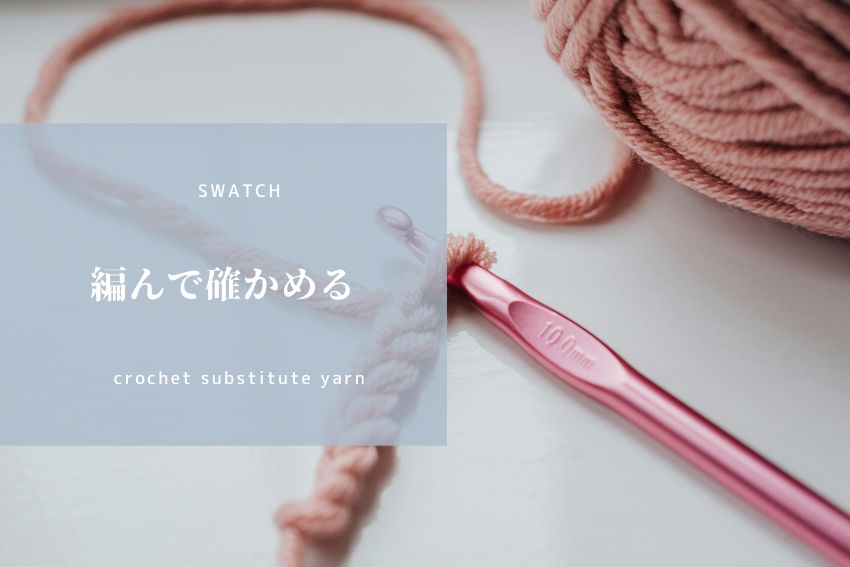
Once you've chosen your alternative yarn, do a test swatch before you start knitting the main body. Even if the numbers are similar, the actual finished product can often look quite different.
Measure the gauge
Knit a 15cm square using the same knitting method as shown in the pattern. Ignore the stitches at the edges, and count the number of stitches and rows in the central 10cm square, then compare it to the gauge shown in the pattern.
- If there are many stitches (small knitted fabric) → Use needles 1-2 sizes thicker.
- If the number of stitches is small (the knitted fabric is large) → Use needles one or two sizes smaller.
For example, even if a knitting pattern calls for a 5/0 needle, a 6/0 needle might be a better match with a substitute yarn. Prioritize matching the gauge over strictly adhering to the needle size specified in the pattern.
Check the texture
Even if the gauge is correct, the resulting fabric may be too stiff or too soft. Check the fabric by touch to ensure it's suitable for your project.
Try washing it.
For projects that may be washed, such as clothing, try washing and drying a test swatch. This will allow you to observe shrinkage, stretching, color fading, and changes in texture. Measuring the gauge after washing will provide even more accurate results.
If the thickness doesn't match, adjust it by "aligning".
If you can't find yarn of the right thickness, you can also use "double-strand" or "plied" techniques, where you knit with two thinner strands of yarn together.
When you use two strands of the same yarn, the length per gram is approximately halved. For example, if you want to match the specified yarn length of 2.0m per gram, you would use two strands of thinner yarn, each approximately 4m long per gram. Since you need two strands, you double the total length when calculating the number of balls of yarn needed.
By combining different yarns, you can create colors and textures that aren't available in commercially produced yarns. For example, you can combine wool with mohair for a soft, fluffy look, or mix two colors for a heathered effect. Searching for alternative yarns can be the starting point for enjoying the process of creating your own unique yarns.
However, when held together, the yarn can easily split, and it may become difficult to pick up stitches. Always do a test swatch before using it.
Things to keep in mind when using alternative yarns for crochet projects
The specific points to pay attention to when using alternative yarn vary depending on what you are making.
| the work | Things to be careful about |
|---|---|
| Amigurumi | The finished size will change depending on the thickness of the yarn. Make sure the knit is tightly woven so that the stuffing inside doesn't show through. |
| Wear | This is the piece that has the biggest impact on the size. Be sure to match the gauge and check the weight and stretch of the material. |
| Hats and mittens | Consider the differences in stretch and texture of the knitted fabric. Choose from smooth cotton, stretchy wool, and other materials to suit your project and intended use. |
| bag | Strength and shape retention are important. Avoid yarns that stretch easily. Tightly twisted yarns tend to be more durable. |
| Shawl/Stole | There's a high degree of flexibility in sizing. Many designs utilize patterned knitting, so if you're unsure, straight yarn is a good choice. |
| Accessories | Even a slight difference in thickness can drastically change the overall impression of the finished product, making it look either bulky or too delicate. Be sure to check the texture as well. |
Helpful ways to find alternative yarns for crochet.
Manufacturer's official website
Yarn manufacturers' websites list the weight, length, standard gauge, and recommended needle size for each yarn. Some sites also allow you to filter by thickness and material on their yarn catalog pages. Even discontinued yarns can sometimes have their specifications found by searching by their name.
Ask for advice at a craft store.
Consulting with the store staff is also a good idea. When you do, it will be helpful if you can tell them the "yarn," "needles," and "gauge" specified in the knitting pattern. Being able to actually touch and compare the candidate yarns is another advantage of going to a store.
Searching for yarn from overseas
You can also check the specifications of overseas yarns on the manufacturer's website, and for discontinued yarns or yarns for which you cannot find information on the website, check the knitting community site "RavelryYou can look it up in the "thread database".
The "YarnSubThere is also a website called "[website name]".
Overseas yarns often express their thickness using terms like "DK" or "Worsted," but even then, comparing them by weight and length is the most reliable method.
Since the length is sometimes given in yards, let's convert it using the formula 1 yard = approximately 0.91 meters.
Consult with AI

You can also use AI such as ChatGPT to suggest alternative yarn options.
Copy the prompt below (instructions for the AI), replace the parts in angle brackets (〈〉), and use it.
However, AI often gives incorrect information about yarn specifications (weight, length, whether it's discontinued, etc.). It may even list yarn names that don't actually exist.
Use the AI's answer as a "hint for finding candidates," and finally, be sure to check the specifications on the manufacturer's official website and do a test knit.
Prompt 1: Find alternative yarn candidates
I am looking for alternative yarn for a crochet project. Please suggest 3 to 5 yarns available in Japan that are similar to the specified yarn below. [Information on the specified yarn] ・Yarn name: <Yarn name> (Manufacturer name: <Manufacturer>) ・Material: <Example: 100% wool> ・Weight and length per ball: <〇g・approx. 〇m> ・Standard gauge: <〇 stitches 〇 rows (10cm square)> ・Suitable needle size: <〇/No. 0 needle> ・Yarn shape: <Example: Straight, mohair, etc.> [What to make] <Example: Cardigan, amigurumi, openwork shawl> [Preferences] <Example: I want a glossy yarn, I want to be able to wash it in a washing machine, up to 〇 yen per ball> For each candidate, please tell me the differences from the specified yarn (thickness, material, texture) and any precautions to take when crocheting. If the specifications of the yarn are uncertain, please indicate that.Including that last sentence can reduce the amount of information the AI creates and uses in its responses.
Prompt ②: Calculate the required number of balls
Please calculate the number of balls of substitute yarn needed for crochet. • Designated yarn: 1 ball (〇m), required number of balls (〇 balls) • Substitute yarn: 1 ball (〇m) Please provide the total length (m) and the number of balls of substitute yarn needed (rounded up). Please also tell us how many extra balls we should add.Common mistakes and solutions when using substitute yarns for crochet.
- The thickness should be the same, but the finished product ends up being larger.
Even if the stated thickness is the same, the actual thickness can vary. Also, the gauge will change depending on the yarn's elasticity and the knitter's tension. Before you start knitting, measure the gauge with a test swatch and adjust the needle size accordingly.
- I ran out of thread halfway through.
If you buy the exact same number of balls as specified, you might run out if one ball of substitute yarn is shorter than the specified amount. It's best to calculate the number of balls based on the total length and have one extra ball on hand to be safe.
- It changed shape after washing.
The way a fabric shrinks or stretches after washing will vary depending on the material. For projects that will be washed, it's best to wash a test piece first to check the properties before knitting the main body.
- The pattern doesn't come out as nicely as in the finished product photo in the pattern book.
Mohair, heathered, or variegated yarns can make patterns difficult to see. For projects where you want the pattern to stand out clearly, it's best to choose straight, solid-colored yarn.
Summary: Expand your crochet fun with alternative yarns.
The following three points are important when choosing an alternative yarn:
- Thickness is compared by "length per gram".
- The number of beads is calculated based on the "total length," and extra beads are added for larger pieces.
- Finally, do a test knit to check the gauge, texture, and how the pattern looks.
If you keep these three things in mind, you can knit your projects with confidence even without the specified yarn.
One of the fun things about knitting is that changing the yarn can result in a completely different look, even with the same pattern.
At Ronique, we offer free knitting patterns and paid patterns (knitting charts) in our online shop. Please try knitting with your favorite yarn.

