
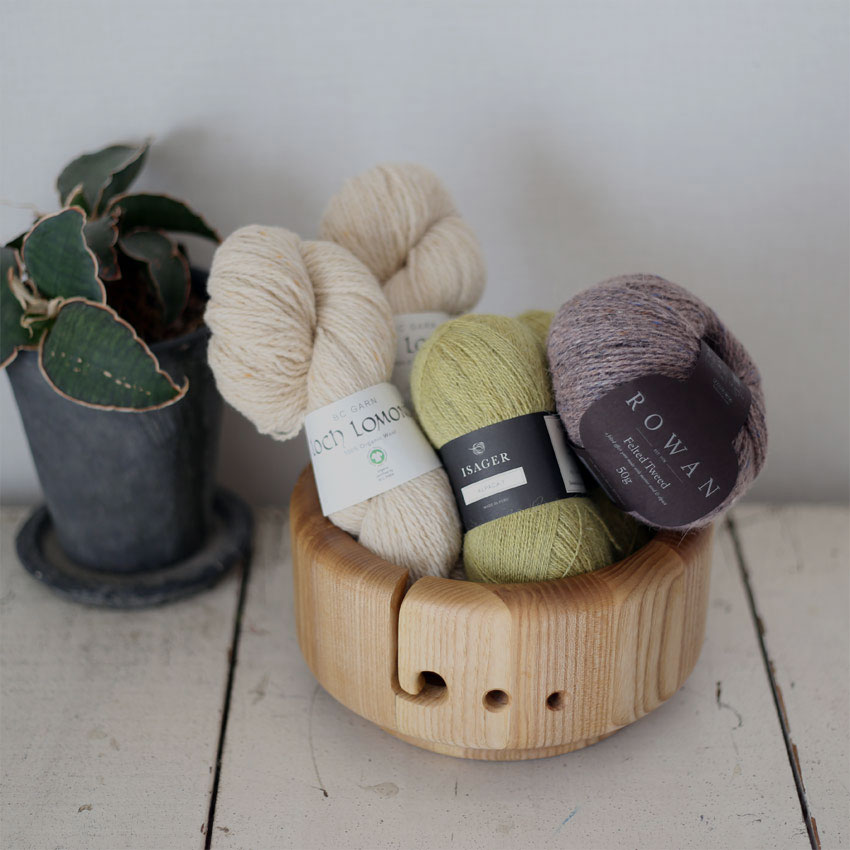
What tools do you need to start crocheting? We will introduce some of the tools you need. Crocheting is a very easy knitting technique, and the tools are compact!
To put it bluntly, the minimum tools you need are a crochet hook and a sewing needle.
From there on, as you start to enjoy crocheting, you'll probably end up collecting all sorts of fan items. We'll introduce some useful tools for crocheting, including these.
On another page,Crochet hook sizes in Japan and overseas" is also included, so please use it if you need it.
Index
Crochet hook -metal-
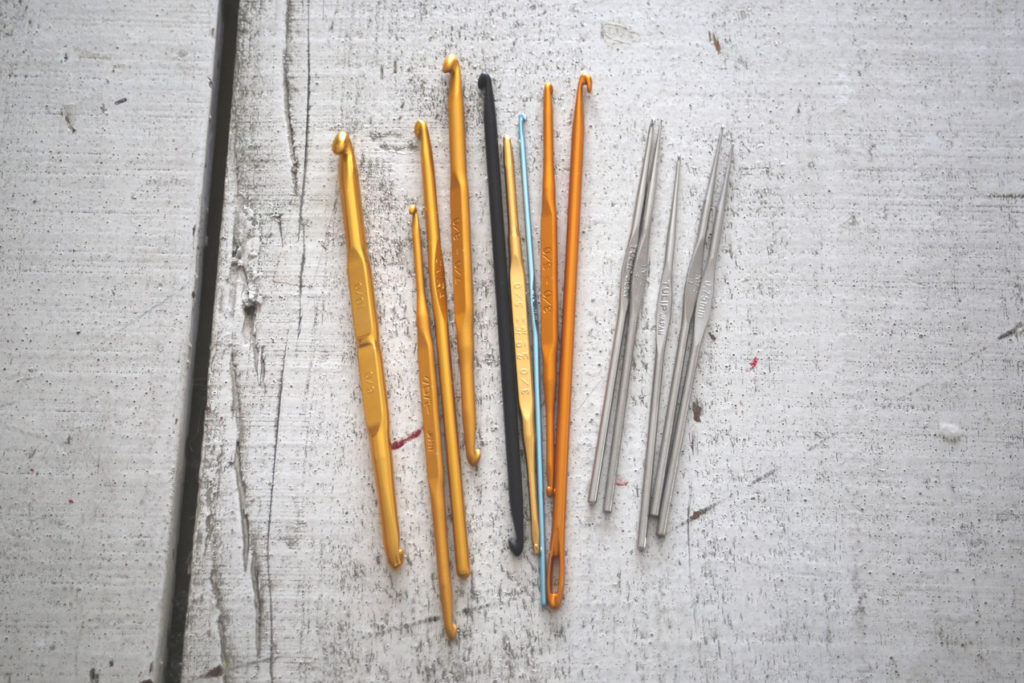
Metal crochet hooks are a common and commonly used tool.
There are single crochet hooks, which have a hook on only one side, and double crochet hooks, which have a hook on both ends. Double crochet hooks come in pairs, such as size 3 and 5, size 4 and 6, and size 7 and 8. One hook is convenient because it can be used for both medium-thin and medium-weight yarns.
For example, if you are knitting with medium-fine yarn on size 3, medium-thick yarn on size 5, and raffia-style yarn on size 7, you can knit almost anything with just two double-ended crochet hooks.
As you knit various things, find the size that suits the tightness and looseness of your hands.
The thin silver crochet hook on the right is a needle for knitting lace. You can knit lace in the same way as with a crochet hook. The lace thread used specifically for lace knitting is very thin, so this needle is designed to match that.


Crochet Hook -With Grip-
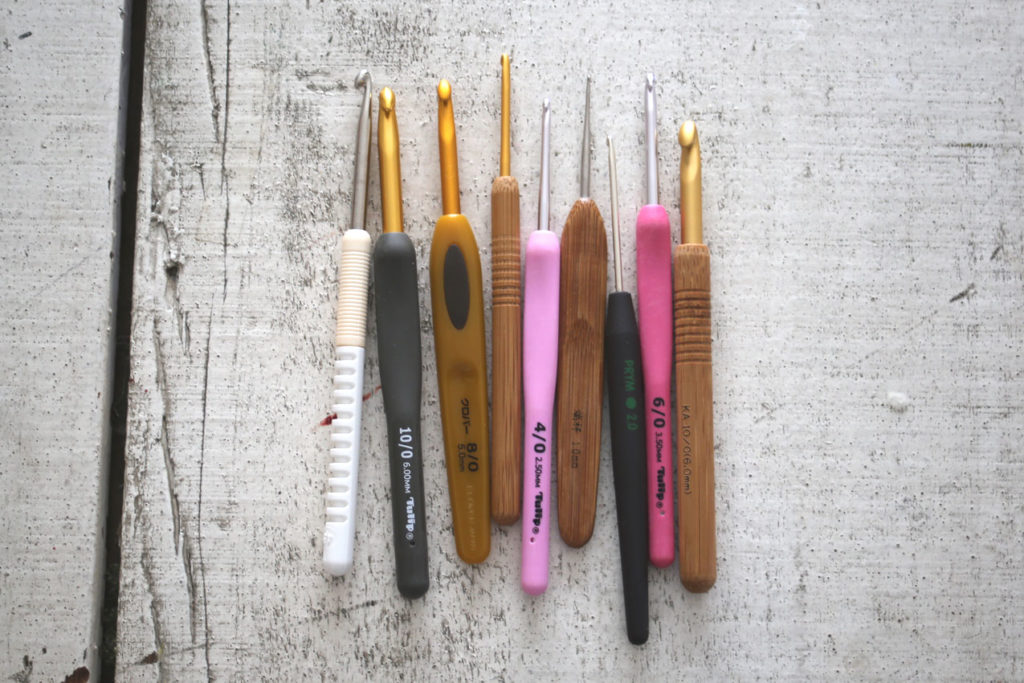
There are also crochet hooks with grips that are designed to be easier to hold, with the part you hold in your hand being thicker or flatter than the tip of the hook. I think many people love these types.
In particular, when knitting with thick yarn, you may find that these types of crochet hooks are easier to use, as they require more force when knitting. You might also want to try using a slightly larger needle, such as a size 7 or 8, to see how it feels to use.


Crochet Hooks -Wooden and Other-
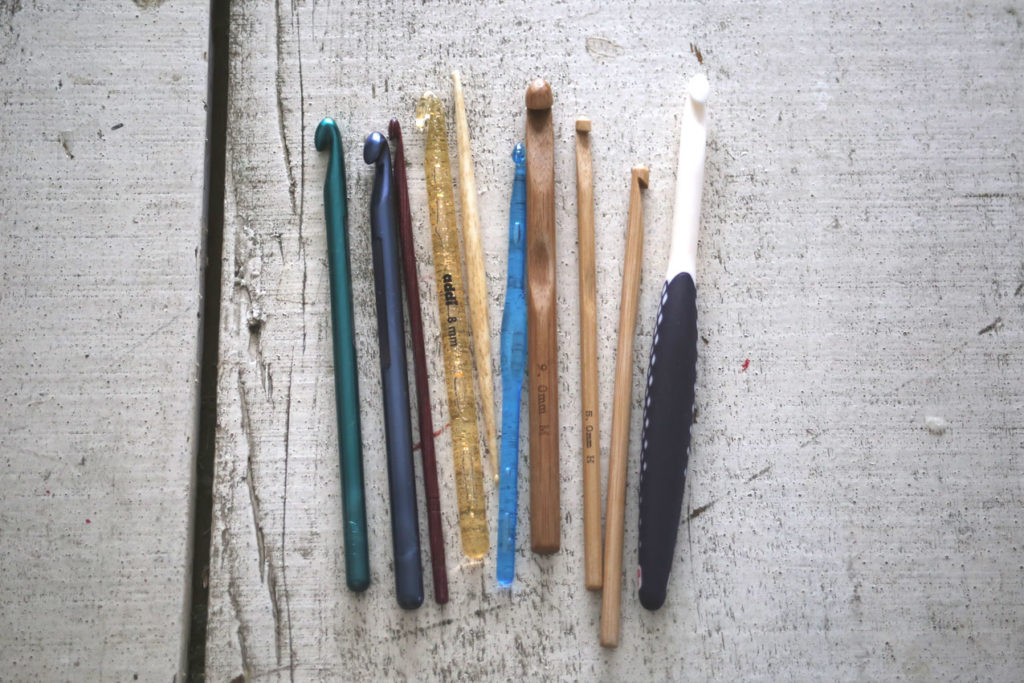
Crochet hooks come in both wooden and plastic. Wooden hooks come in a range of sizes, from small to large, while plastic hooks tend to be larger in size.
When knitting with thick yarn, using a crochet hook made of a lightweight material like this will keep your hands from getting tired. Plastic crochet hooks come in a variety of colors and are visually appealing, so when you find a unique one, you can't help but be drawn to it.


Yarn needles and stitch markers
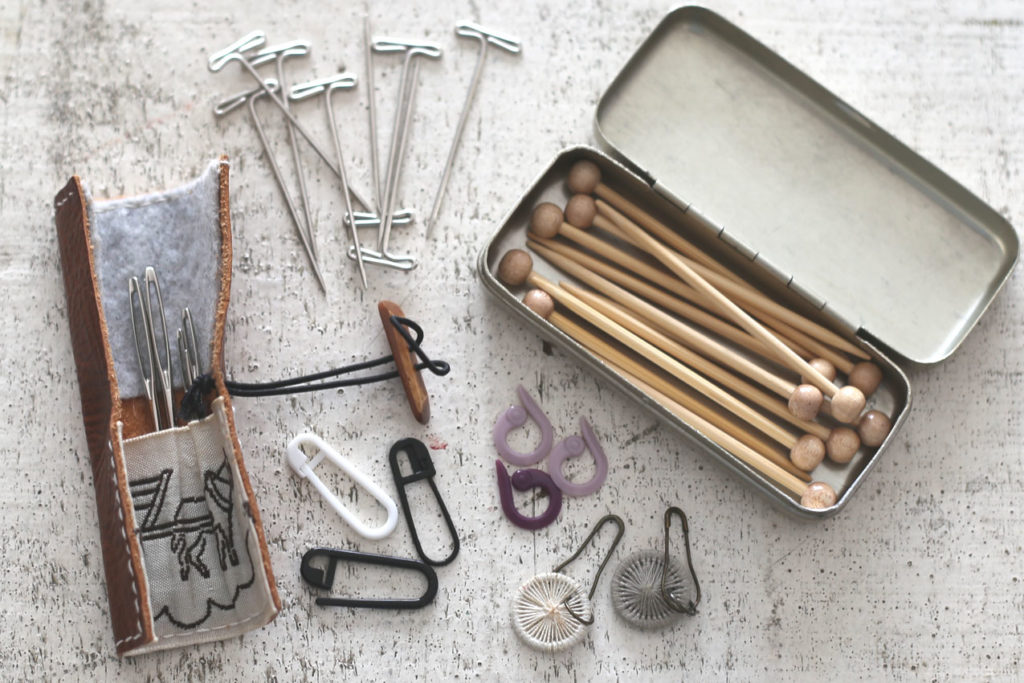
When making crocheted items, you always need to use a knitting needle to finish off the yarn after you finish. Any knitting needle will do as long as the yarn you were knitting with can pass through the eye of the needle. In addition to metal knitting needles, there are also plastic knitting needles.
You can find them at 100 yen shops, so be sure to have one on hand along with your crochet hook.
The T-shaped pin in the top center of the photo is used to hold the knitted fabric together. The bamboo pins in the case also serve the same purpose.
The safety pin-shaped object, the pin with the round decoration, and the purple round tool in the bottom center of the photo are all stitch markers. Place them on your knitting to mark the stitches.
It can be used in a variety of ways, such as attaching it to the starting stitch to prevent passing over the change in row, attaching it to the position where you attach the handle of a bag, or using it as a marker to count the number of stitches in a long chain knitting.
For knitting with needles, there are circle-shaped markers with completely closed rings, but when using a crochet hook, you won't be able to remove them (lol), so be sure to use a ring with a gap or a pin type.
You can use a stitch marker by attaching a short piece of thin leftover yarn to your knitting, so you don't need to prepare them all from the start.


Yarn cutter/counter
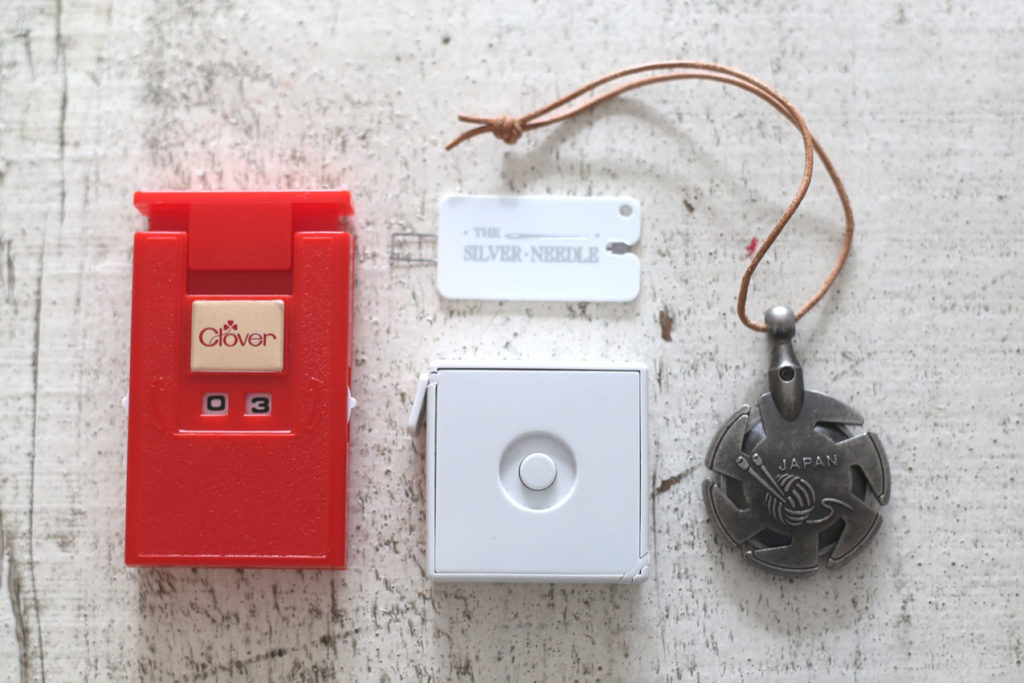
These tools can be used not only for crocheting, but the one on the left is a row counter, the one in the bottom center is a tape measure, and the ones in the top center and on the right are yarn cutters.
Normally, you can cut yarn with scissors, but knitting enthusiasts who want to continue knitting even when they're on an airplane might find a yarn cutter attractive, as it (probably) won't be collected at the boarding gate.
A tape measure isn't used very often, but it is useful when taking gauges.
As for the step counter... I can't quite get the hang of it because I always forget whether I've pressed the counter or not (lol). When I need to check the step count, I can write the character "正" (正) on a notepad, but as a tool, this kind of thing is cute and has a niche feel to it.


Yarn Bowl
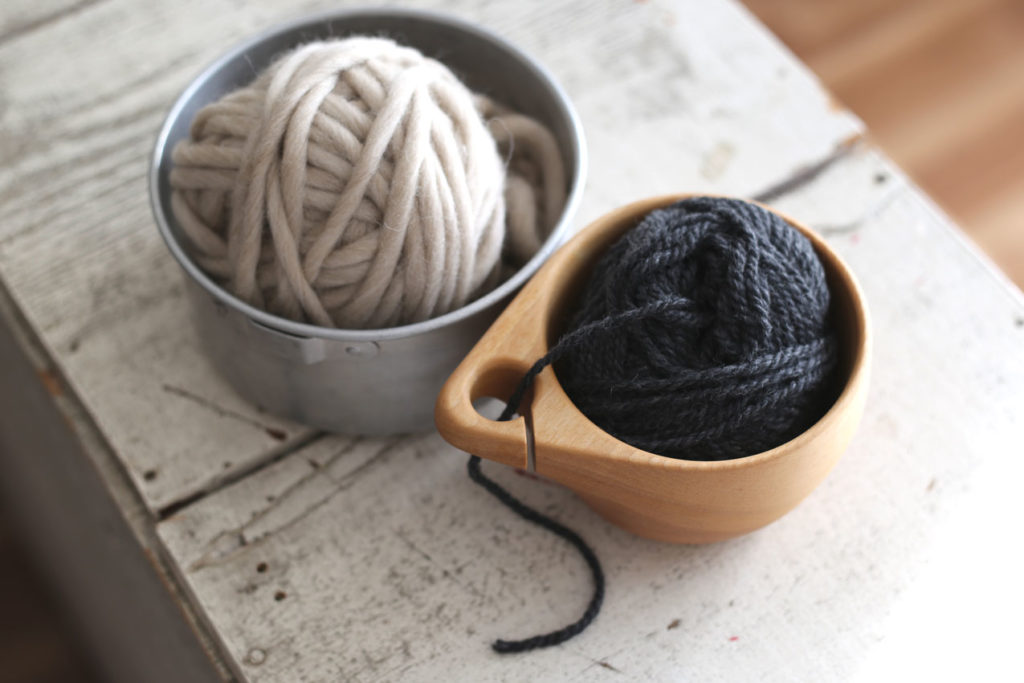
Yarn bowls are an item that knitting fans will want to own. They are considered a standard knitting tool overseas.
You can knit without it, but it's convenient to have one so the ball of yarn doesn't roll away.
In terms of not rolling around, you can use a variety of things as a substitute, so it's a good idea to try using things you have at home. By the way, the round aluminum container on the left is not a yarn bowl, but it just happened to be the right size, so I've been using it for knitting for a long time.


Yarn winding machine/skein machine

When you purchase a skein of yarn (a bundle of yarn that is not in a ball), you will need a thread winder or skein reel.
The skein of thread is spread out and put on the skein winder, and the end of the thread is hooked onto the bobbin and spun around, causing the skein to also spin around and create a ball of thread on the bobbin.
Again, you can wind thread without this, but it dramatically simplifies the process and saves time, so it's very useful if you start using skeins of thread frequently.
The long, thin stick in the foreground is a nostepin, a tool used to make a ball of yarn by winding the yarn by hand. If you use this to rewind leftover yarn that has become misshapen, you can make a cute little ball of yarn.


So far, we have introduced the tools used for crocheting.
There are essential tools and tools that add to the fun of knitting. Using your favorite tools is one of the joys of knitting!
As you continue your knitting life, find your favorite tools.
Introducing the Top 3 Most Popular Patterns | Ronique Store
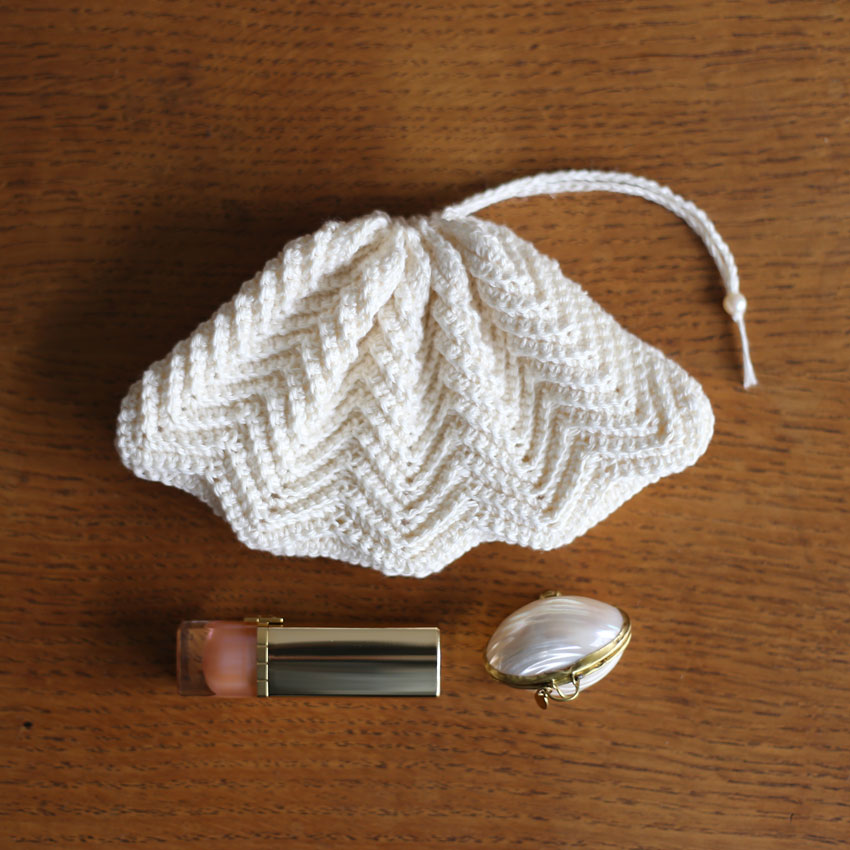
[No.1] Seashell Pouch
This has been our best-selling product since its release, consistently being our most popular item.
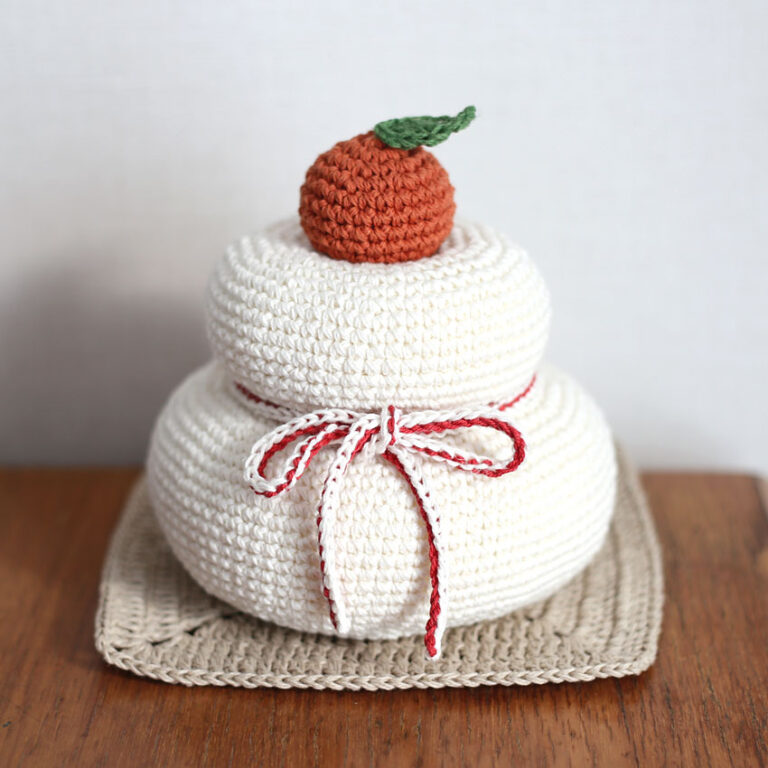
[No.2] Assembled Kagami-Mochi
With its distinctive construction, this seasonal favorite is as fun to crochet as it is to use.
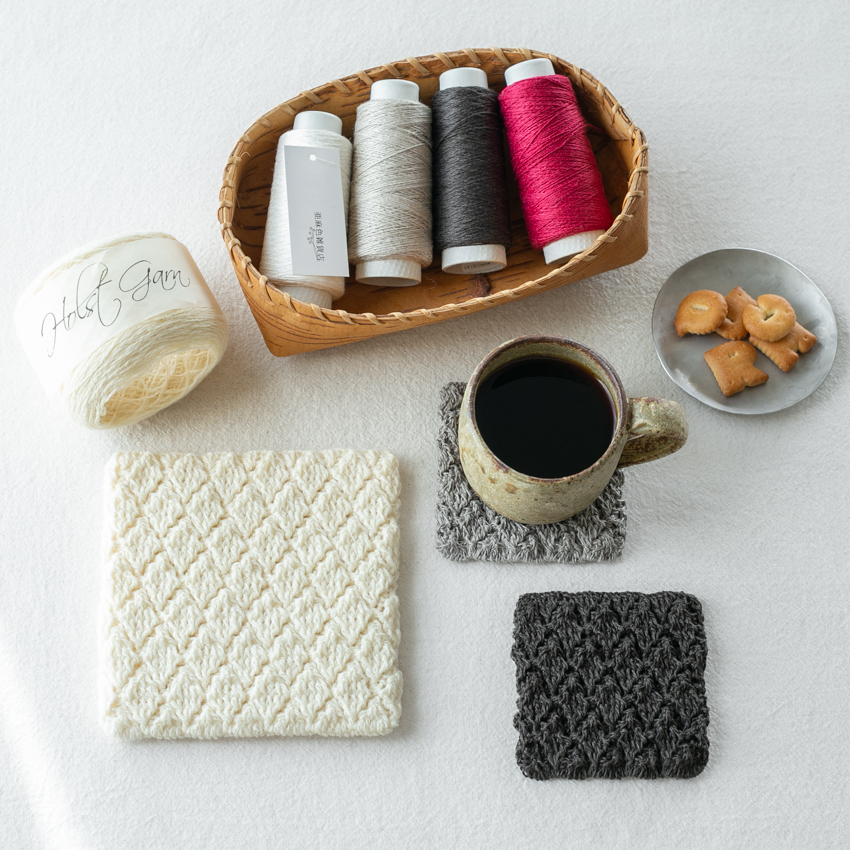
[No.3] Mindful Mat
This popular product is easy to use for everyday wear, and its three-dimensional texture really stands out.

